
The Match Nobody Expected to End This Way
Two unbeaten teams. A 201-run target. A 16-year-old walking in at number two.
Guwahati’s Barsapara Cricket Stadium on April 10 had every ingredient for a tense, edge-of-seat finish. Royal Challengers Bengaluru had just posted 201/8 a total they had every right to feel good about, given that their innings had survived a top-order collapse that should have left them stranded at 76/5.
But here is the real problem with how the night unfolded for RCB: their bowling attack, structured for containment, walked straight into a batter who does not understand the concept of containment.
Vaibhav Sooryavanshi arrived at the crease at 21/1 in the second over. When he left, the scoreboard read 134/4. He had personally deposited 78 runs in 26 balls, at a strike rate of 300.00, with 7 sixes. The chase was effectively over in 8 overs. This was not luck. This was a teenager with the composure of a ten-year veteran dismantling a world-class bowling attack with surgical precision.
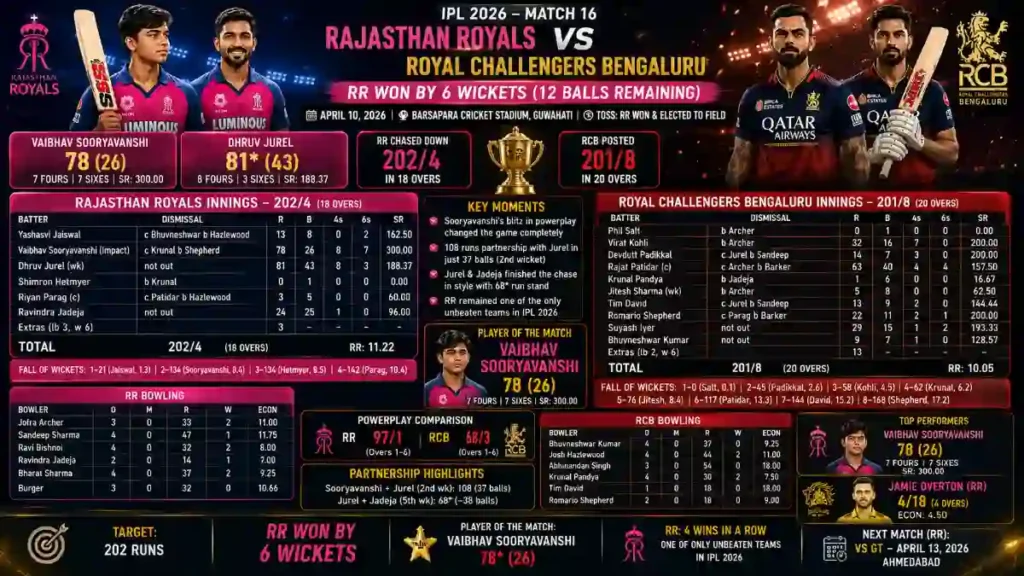
The Rajasthan Royals vs Royal Challengers Bengaluru match scorecard tells you the numbers. This article explains exactly what happened behind them.
Match Summary
| Detail | Information |
| Match | 16th Match, IPL 2026 |
| Venue | Barsapara Cricket Stadium, Guwahati |
| Date | April 10, 2026 |
| Toss | Rajasthan Royals (elected to field) |
| Result | Rajasthan Royals won by 6 wickets (12 balls remaining) |
| RCB Score | 201/8 (20 overs) |
| RR Score | 202/4 (18 overs) |
| Player of the Match | Vaibhav Sooryavanshi (78 off 26) |
| Impact Player Used | RR: Vaibhav Sooryavanshi (in for Sandeep Sharma) |
Analysis is based on official scorecard data from ESPNcricinfo and Sky Sports.
RCB Innings: The Story Behind 201/8
RCB scored 201/8 in 20 overs a total that, on paper, deserved to win. In reality, it was built on a crumbling foundation.
RCB Batting Scorecard
| Batter | Runs | Balls | 4s | 6s | SR |
| Phil Salt | 0 | 1 | 0 | 0 | 0.00 |
| Virat Kohli | 32 | 16 | 7 | 0 | 200.00 |
| Devdutt Padikkal | 14 | 7 | 3 | 0 | 200.00 |
| Rajat Patidar (c) | 63 | 40 | 4 | 4 | 157.50 |
| Krunal Pandya | 1 | 6 | 0 | 0 | 16.67 |
| Jitesh Sharma (wk) | 5 | 8 | 0 | 0 | 62.50 |
| Tim David | 13 | 9 | 2 | 0 | 144.44 |
| Romario Shepherd | 22 | 11 | 2 | 1 | 200.00 |
| Suyash Iyer | 29* | 15 | 1 | 2 | 193.33 |
| Bhuvneshwar Kumar | 9* | 7 | 1 | 0 | 128.57 |
RCB Phase-by-Phase Scoring
| Phase | Overs | RCB Score | Wickets |
| Powerplay | 0.1 – 6.0 | ~68 | 3 |
| Middle Overs | 7 – 15 | ~58 | 3 |
| Death Overs | 16 – 20 | ~75 | 2 |
The Fall of Wickets A Collapse in Plain Sight
RCB’s top five contributed fewer than 65 runs combined. The innings was rescued entirely by the lower order.
- Phil Salt: 0 off 1 ball first delivery, first wicket
- Devdutt Padikkal: out at 45/2 (2.6 overs)
- Virat Kohli: gone at 58/3 (4.5 overs)
- Krunal Pandya: out at 62/4 (6.2 overs)
- Jitesh Sharma: dismissed at 76/5 (8.4 overs)
By the end of over 9, RCB had lost five wickets and were at 76. This is not a competitive batting performance this is a top order collapse that would have left most teams posting 140.
What saved RCB was an extraordinary lower-order revival: Patidar added 125 runs across partnerships with Shepherd (22 off 11), Suyash Iyer (29* off 15), and Bhuvneshwar Kumar (9* off 7). That is the definition of a rescue act, not a team batting plan.
What People Think vs Reality About RCB’s 201
Most commentators called RCB’s total “competitive.” The reality is that 201 was built on a structural fault line. When your middle order Krunal Pandya (1 off 6), Tim David (13 off 9) contributes 14 runs combined in a T20 innings, you are relying on the lower order to cover a gaping hole. That works sometimes. Against a RR chase unit in this form, it was always going to be insufficient.
RR Chase: When a 16-Year-Old Changed Every Equation
The Rajasthan Royals vs Royal Challengers Bengaluru match scorecard will show 202/4 in 18 overs. What it will not show is how completely lopsided this chase was within the first eight overs.
RR’s powerplay score 97 runs for 1 wicket is one of the most remarkable powerplay figures in IPL 2026, and arguably in IPL history for a 200-plus chase. That is not a chase. That is a statement.
RR Batting Scorecard
| Batter | Runs | Balls | 4s | 6s | SR |
| Yashasvi Jaiswal | 13 | 8 | 0 | 2 | 162.50 |
| Vaibhav Sooryavanshi (Impact) | 78 | 26 | 8 | 7 | 300.00 |
| Dhruv Jurel (wk) | 81* | 43 | 8 | 3 | 188.37 |
| Shimron Hetmyer | 0 | 1 | 0 | 0 | 0.00 |
| Riyan Parag (c) | 3 | 5 | 0 | 0 | 60.00 |
| Ravindra Jadeja | 24* | 25 | 1 | 0 | 96.00 |
RR Phase-by-Phase Chase Breakdown
| Phase | Overs | RR Score | Wickets |
| Powerplay | 0.1 – 6.0 | 97 | 1 |
| Middle Overs | 7 – 15 | ~75 | 3 |
| Death Overs | 16 – 18 | ~30 | 0 |
Key Partnership Data
| Partnership | Batters | Runs | Balls |
| 2nd Wicket | Sooryavanshi + Jurel | 108 | ~37 |
| 5th Wicket | Jurel + Jadeja | 68 | ~38 |
RR Bowling Figures vs RCB
| Bowler | Overs | Runs | Wickets | Economy |
| Jofra Archer | 3 | 33 | 2 | 11.00 |
| Sandeep Sharma | 4 | 47 | 1 | 11.75 |
| Ravi Bishnoi | 4 | 32 | 2 | 8.00 |
| Ravindra Jadeja | 2 | 14 | 1 | 7.00 |
| Bharat Sharma | 4 | 37 | 2 | 9.25 |
| Burger | 3 | 32 | 0 | 10.66 |
RCB Bowling vs RR Chase
| Bowler | Overs | Runs | Wickets | Economy |
| Bhuvneshwar Kumar | 4 | 37 | 0 | 9.25 |
| Josh Hazlewood | 4 | 44 | 2 | 11.00 |
| Abhinandan Singh | 3 | 54 | 0 | 18.00 |
| Krunal Pandya | 4 | 30 | 2 | 7.50 |
| Tim David | 1 | 18 | 0 | 18.00 |
| Romario Shepherd | 2 | 18 | 0 | 9.00 |
The Real Turning Point: Overs 1–8
The match was decided not in the death overs. It was decided between overs 1 and 8.
Yashasvi Jaiswal fell in the second over with the score at 21/1. What happened next was one of the defining passages of IPL 2026 batting. Vaibhav Sooryavanshi, entering as the Impact Player substitute, and Dhruv Jurel put on 108 runs off just 37 balls in a second-wicket partnership that effectively ended the contest before the halfway mark of the chase.
What most people miss is the tactical dimension of this partnership. RCB had built their bowling plan around using Bhuvneshwar Kumar and Josh Hazlewood upfront experienced, reliable death and swing bowlers before introducing Abhinandan Singh in the middle overs when conditions typically suit spin and a settled line and length.
Sooryavanshi broke that plan completely. Abhinandan Singh conceded 54 runs from 3 overs at an economy of 18.00. The plan to contain in the middle overs collapsed entirely. By the time RCB adjusted, the required run rate had become irrelevant.
This is where things go wrong for containment-first bowling strategies: when a single batter refuses to accept the role that the bowling attack has assigned to them, the entire tactical structure falls apart.
Match Timeline
| Over | Key Event | Score |
| 0.1 | Jofra Archer takes wicket first ball (Phil Salt, 0) | RCB: 0/1 |
| 1.3 | Virat Kohli 32 off 16, rapid but brief | RCB building |
| 4.5 | Kohli dismissed RCB at 58/3 | Collapse begins |
| 6.2 | RCB 62/4 Pandya gone | 3 wickets in 2 overs |
| Powerplay End | RCB: ~68/5 | Rescue required |
| 2nd over (RR) | Jaiswal falls 21/1 | Impact Player enters |
| 2–8 (RR) | Sooryavanshi-Jurel add 108 off 37 | Match over effectively |
| Over 18 | Jurel levels scores with a six off Shepherd | Win secured |
Sooryavanshi at SR 300: The Counterintuitive Truth
A strike rate of 300 looks reckless from the outside. Watch the footage, and it looks like a batting masterclass.
People assume big hitting at a SR of 300 means wild swings and luck. The reality is the opposite. Sooryavanshi’s 78 off 26 balls included 8 fours and 7 sixes and the boundary distribution tells you this was not cross-batted slogging. Each six was hit into a specific zone. The footwork was decisive and pre-committed. The shot selection was based on field placements, not reaction.
This is what separates elite power hitters from ordinary six-hitters:
- Reading the bowler’s release point before delivery
- Pre-committing to a hitting zone based on the field set
- Playing the same shot whether the delivery is full or short
- Operating with zero doubt no hesitation, no second-guessing
Sooryavanshi’s seven sixes were not accidents. They were decisions. At age 16, in a pressure 200-plus chase, this level of game awareness is genuinely unprecedented in modern IPL history.
Bold observation: Sooryavanshi’s 78 off 26 will be cited in batting curriculum discussions for years not for the strike rate, but for what the innings revealed about his match awareness under pressure. This is a player who does not think in terms of risk the way most batters do. That is the rarest quality in cricket.
Dhruv Jurel: The Match-Winner Nobody Headlines
While Sooryavanshi dominated every post-match headline, Dhruv Jurel’s 81 not out off 43 balls was the innings that actually won the match.
Here is the moment most analysis glosses over. When Sooryavanshi fell after his 78, RR were 134/4. Shimron Hetmyer gone for zero. Riyan Parag gone for three. Suddenly RR needed 68 more runs off 62 balls with only Jadeja to come. That is a genuine pressure scenario.
Jurel did not panic. He absorbed the collapse, built a 68-run partnership with Ravindra Jadeja (24* off 25), and accelerated precisely when needed. His last 41 runs came from approximately 25 balls. He finished the match by hitting Romario Shepherd for a six that levelled the scores in the 18th over, then took the winning run on the next ball.
This is the composure of a match-winner. Jurel operated as both anchor and finisher in the same innings one of the most underrated skill combinations in T20 batting.
RCB’s Structural Batting Problem: Not a Bad Day, a Pattern
The collapse was not a one-off. It was a pattern.
In the Rajasthan Royals vs Royal Challengers Bengaluru match scorecard, RCB’s top five contributed approximately 65 runs combined. Their total of 201 was built by:
- Rajat Patidar: 63 off 40 (middle order anchor)
- Romario Shepherd: 22 off 11 (lower order)
- Suyash Iyer: 29* off 15 (lower order)
- Bhuvneshwar Kumar: 9* off 7 (tail)
That is 123 runs from positions 4, 8, 9, and 10. The upper order and middle order contributed fewer than 80. When your batting blueprint depends on the lower order rescuing a collapse regularly, it is not resilience it is a structural fault that high-quality bowling attacks will always punish.
Notably, Jofra Archer took a wicket on the first ball of an innings for the third time in the IPL, dismissing Phil Salt (dismissed on the first ball for the third time in his IPL career). These are not coincidences they are matchup patterns that opposition scouts will have already identified.
Why RR Won: A Clear Five-Point Summary
For fans who want a direct answer, here is exactly why Rajasthan Royals won the Rajasthan Royals vs Royal Challengers Bengaluru match:
- Impact Player system worked perfectly Sooryavanshi entered at 21/1 and changed the match in 26 balls
- Powerplay execution was extraordinary RR scored 97/1 in 6 overs, the highest powerplay score in a 200-plus chase this IPL 2026 season
- Sooryavanshi-Jurel partnership (108 off 37) effectively ended the match before the 10th over
- Jurel’s composure through the middle-order collapse kept the chase alive when it could have derailed
- Ravi Bishnoi (2/32) and Jadeja (1/14 at 7.00) kept RCB honest in the death overs during the first innings
Why RCB Lost: The Direct Answer
- Top-order collapse: 5 wickets lost by over 9 for just 76 runs
- Middle order failure: Pandya (1 off 6), Tim David (13 off 9) contributed almost nothing
- Abhinandan Singh’s economy (18.00) shattered their bowling plan
- No second Impact Player lever to match RR’s tactical flexibility
- Total of 201 was built on lower-order heroics, not structured batting depth
Four-in-Four: What This Win Means for RR’s Season
After this result, Rajasthan Royals were one of only two unbeaten teams in IPL 2026 alongside Punjab Kings.
That single stat changes the context of the entire night. This was not just a match win. It was a statement about the depth and adaptability of RR’s squad. Their Impact Player strategy is working. Their power-hitting is functioning at both ends of the innings. Their bowling, even without Sandeep Sharma as a first XI bowler (replaced by Sooryavanshi), was disciplined enough to contain a strong RCB lineup.
RR’s second 200-plus total against RCB in IPL history came in this very match 202/4. Their first was the 217/4 in Bengaluru back in 2018. That historical footnote captures something important: this RR batting lineup, when fully activated, is capable of scoring in territory that most teams simply cannot match.
Read More About – Delhi Capitals Vs Chennai Super Kings Match Scorecard: Samson’s 115 Dismantles Delhi Capitals
RR vs RCB Head-to-Head Record: The Bigger Picture
| Match | Venue | Result | Margin |
| IPL 2026, Match 16 | Guwahati | RR won | 6 wickets |
| IPL 2025, 42nd Match | Bengaluru | RCB won | 11 runs |
| IPL 2025, 28th Match | Jaipur | RCB won | 9 wickets |
| IPL 2024 Eliminator | Ahmedabad | RR won | 4 wickets |
Overall: RR have won 15, RCB have won 17 in 35 IPL meetings with RCB holding a narrow head-to-head edge.
What the numbers show is a clear pattern: RCB win more frequently on home conditions and in regular season matches, but RR win the high-pressure matches. The 2024 Eliminator victory and this dominant 2026 chase confirm that Rajasthan Royals have the tactical flexibility and squad depth to outperform RCB when the stakes are highest.
Frequently Asked Questions
Q1. What was the result of the Rajasthan Royals vs Royal Challengers Bengaluru match in IPL 2026?
Ans. Rajasthan Royals beat Royal Challengers Bengaluru by 6 wickets in Match 16 of IPL 2026 at Barsapara Cricket Stadium, Guwahati. RCB scored 201/8 in 20 overs. RR chased it down in 18 overs, finishing at 202/4 with 12 balls to spare.
Q2. What was the full scorecard of RR vs RCB IPL 2026 Match 16?
Ans. RCB: 201/8 (20 ov) Rajat Patidar 63(40), Suyash Iyer 29*(15), Romario Shepherd 22(11). RR: 202/4 (18 ov) Dhruv Jurel 81*(43), Vaibhav Sooryavanshi 78(26), Ravindra Jadeja 24*(25).
Q3. Who scored the most runs for Rajasthan Royals against RCB in IPL 2026?
Ans. Dhruv Jurel top-scored for RR with an unbeaten 81 off 43 balls. Impact Player Vaibhav Sooryavanshi scored a stunning 78 off 26 at a strike rate of 300.00.
Q4. Who was the top scorer for RCB in the RR vs RCB match?
Ans. Rajat Patidar was RCB’s highest scorer with 63 off 40 balls at SR 157.50. Suyash Iyer contributed 29* off 15 in the lower order to help RCB reach 201.
Q5. What was the powerplay score in the RR vs RCB IPL 2026 match?
Ans. RCB scored approximately 68 runs in their powerplay, losing 3 wickets. RR’s powerplay was far more explosive 97 runs for 1 wicket in 6 overs, fuelled by Sooryavanshi’s impact player entry.
Q6. Who took the most wickets for RR vs RCB in IPL 2026 Match 16?
Ans. For RR in the first innings, Jofra Archer, Ravi Bishnoi, and Bharat Sharma each took 2 wickets. For RCB in the chase, Josh Hazlewood and Krunal Pandya each took 2 wickets.
Q7. What was Vaibhav Sooryavanshi’s role in the RR vs RCB match?
Ans. Sooryavanshi entered as an Impact Player substitute, replacing Sandeep Sharma after the first wicket fell. He scored 78 off 26 balls (SR 300.00, 8 fours, 7 sixes) and added 108 off 37 balls with Dhruv Jurel.
Q9. What was Rajasthan Royals’ record in IPL 2026 after beating RCB?
Ans. Following the RR vs RCB IPL 2026 result, Rajasthan Royals had won all four of their matches to become one of only two unbeaten teams in the tournament, alongside Punjab Kings.
Q10. What is the head-to-head record between RR and RCB in IPL history?
Ans. In 35 IPL meetings, RCB have won 17 and RR have won 15, with 3 no-results. However, RR have consistently won the high-pressure matches including the 2024 Eliminator and this 2026 dominant chase.