
At 117 for 6, England had already used up 16.5 overs. They still needed 43 runs from 19 deliveries. Six wickets down. Rachin Ravindra had just claimed his third, and the Colombo crowd – largely neutral but gravitating toward the underdog – had begun to believe the Black Caps were engineering one of the tournament’s defining upsets.
Two batters walked to the crease who weren’t supposed to decide a World Cup knockout-phase match. Will Jacks – technically a spinning allrounder, not a finisher – and Rehan Ahmed – a 21-year-old leg-spinner pushed up the batting order by necessity, not design. In 16 balls, they put on 44 runs together. England won with three balls and four wickets to spare.
The scorecard says England won by four wickets. What it doesn’t say is how close New Zealand came.
Match Summary
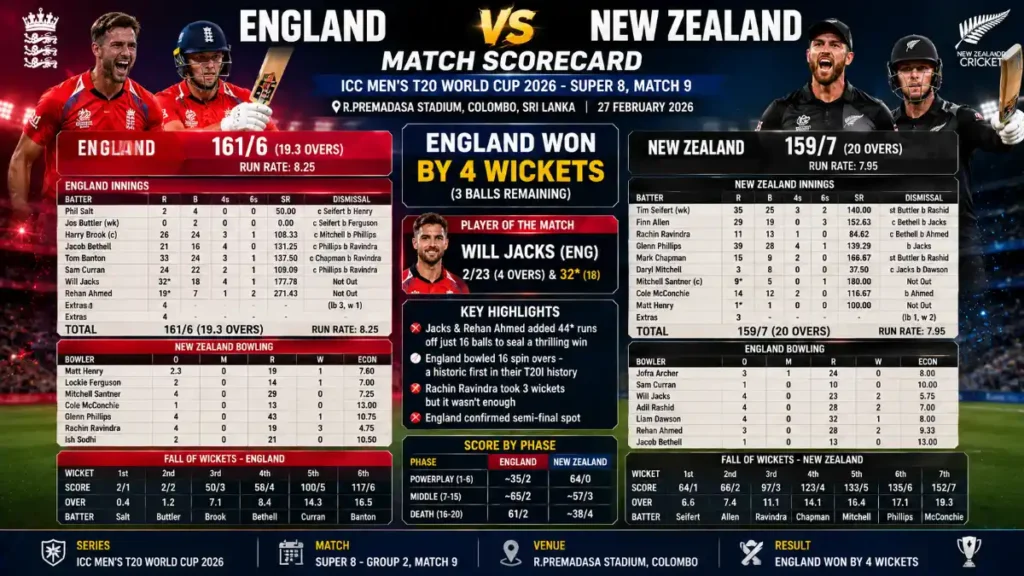
England beat New Zealand by 4 wickets in ICC Men’s T20 World Cup 2026 Super 8 Match 9 at R.Premadasa Stadium, Colombo, on February 27, 2026. New Zealand posted 159/7 in 20 overs (Glenn Phillips 39, Rachin Ravindra 3/19). England chased 160 in 19.3 overs (Will Jacks 32*, Rehan Ahmed 19*; Rachin Ravindra 3/19). Will Jacks won Player of the Match.
| Detail | Info |
| Tournament | ICC Men’s T20 World Cup 2026 |
| Stage | Super 8 – Group 2, Match 9 |
| Date | Friday, February 27, 2026 |
| Venue | R.Premadasa Stadium, Khettarama, Colombo, Sri Lanka |
| Toss | New Zealand won; elected to bat |
| Result | England won by 4 wickets (3 balls remaining) |
| Player of the Match | Will Jacks (2/23 + 32* off 18) |
| Tournament Context | England confirmed semi-final place; NZ’s fate pending PAK vs SL result |
| Source | ESPNcricinfo, Cricbuzz, ICC, CricketSky, CREX, Wisden |
Complete New Zealand Batting Scorecard – 159/7 (20 overs)
New Zealand Innings
| Batter | Dismissal | R | B | 4s | 6s | SR |
| Tim Seifert (wk) | st Buttler b Rashid | 35 | 25 | 3 | 2 | 140.00 |
| Finn Allen | c Bethell b Jacks | 29 | 19 | 0 | 3 | 152.63 |
| Rachin Ravindra | c Bethell b Ahmed | 11 | 13 | 1 | 0 | 84.62 |
| Glenn Phillips | b Jacks | 39 | 28 | 4 | 1 | 139.29 |
| Mark Chapman | st Buttler b Rashid | 15 | 9 | 2 | 0 | 166.67 |
| Daryl Mitchell | c Jacks b Dawson | 3 | 8 | 0 | 0 | 37.50 |
| Mitchell Santner (c) | not out | 9 | 5 | 0 | 1 | 180.00 |
| Cole McConchie | b Ahmed | 14 | 12 | 2 | 0 | 116.67 |
| Matt Henry | not out | 1 | 1 | 0 | 0 | 100.00 |
| Extras | (lb 1, w 2) | 3 | ||||
| Total | 7 wkts | 159 | 20 ov |
Did not bat: Ish Sodhi, Lockie Ferguson
New Zealand Fall of Wickets
| Wicket | Batter | Score | Over |
| 1st | Tim Seifert | 64–1 | 6.6 |
| 2nd | Finn Allen | 66–2 | 7.4 |
| 3rd | Rachin Ravindra | 97–3 | 11.1 |
| 4th | Mark Chapman | 123–4 | 14.1 |
| 5th | Daryl Mitchell | 133–5 | 16.4 |
| 6th | Glenn Phillips | 135–6 | 17.1 |
| 7th | Cole McConchie | 152–7 | 19.3 |
England Bowling vs New Zealand
| Bowler | O | M | R | W | Dots | Econ |
| Jofra Archer | 3 | 1 | 24 | 0 | 10 | 8.00 |
| Sam Curran | 1 | 0 | 10 | 0 | 2 | 10.00 |
| Will Jacks | 4 | 0 | 23 | 2 | 9 | 5.75 |
| Adil Rashid | 4 | 0 | 28 | 2 | 12 | 7.00 |
| Liam Dawson | 4 | 0 | 32 | 1 | 7 | 8.00 |
| Rehan Ahmed | 3 | 0 | 28 | 2 | 3 | 9.33 |
| Jacob Bethell | 1 | 0 | 13 | 0 | 1 | 13.00 |
Most dot balls: Adil Rashid – 12
England bowled 16 spin overs – a historic first in their T20I history
NZ Innings – Phase Breakdown
| Phase | Overs | Runs | Wickets | Key Event |
| Powerplay | 1–6 | 64 | 0 | Seifert + Allen blitz – no early wicket for England |
| Collapse | 7.1–8.4 | 2 | 2 | Jacks removes Allen; Rashid stumps Seifert – 66/2 |
| Middle rebuild | 9–14 | 57 | 2 | Phillips + Chapman repair; Ravindra falls earlier at 97/3 |
| Collapse | 15–17.1 | 12 | 3 | Mitchell, Phillips, and Chapman were dismissed in 8 deliveries |
| Death | 17.2–20 | ~24 | 1 | Santner + McConchie add late impetus; McConchie bowled by Rehan |
Partnership Breakdown – NZ Innings
| Partnership | Batters | Runs | Balls |
| 1st wicket | Seifert + Allen | 64 | 42 |
| 2nd wicket | Allen + Ravindra | 2 | 9 |
| 3rd wicket | Ravindra + Phillips | 31 | 27 |
| 4th wicket | Phillips + Chapman | 26 | 18 |
| 5th wicket | Chapman + Mitchell | 10 | 15 |
| 6th wicket | Mitchell + Santner | 2 | 3 |
| 7th wicket (unbroken) | Santner + McConchie | 17 | 14 |
Complete England Batting Scorecard – 161/6 (19.3 overs)
England Innings
| Batter | Dismissal | R | B | 4s | 6s | SR |
| Phil Salt | c Seifert B Henry | 2 | 4 | 0 | 0 | 50.00 |
| Jos Buttler (wk) | c Seifert b Ferguson | 0 | 2 | 0 | 0 | 0.00 |
| Harry Brook (c) | c Mitchell b Phillips | 26 | 24 | 3 | 1 | 108.33 |
| Jacob Bethell | c Phillips b Ravindra | 21 | 16 | 4 | 0 | 131.25 |
| Tom Banton | c Chapman b Ravindra | 33 | 24 | 3 | 1 | 137.50 |
| Sam Curran | c Phillips b Ravindra | 24 | 22 | 2 | 1 | 109.09 |
| Will Jacks | not out | 32 | 18 | 4 | 1 | 177.78 |
| Rehan Ahmed | not out | 19 | 7 | 1 | 2 | 271.43 |
| Extras | (lb 3, w 1) | 4 | ||||
| Total | 6 wkts | 161 | 19.3 ov |
Did not bat: Liam Dawson, Adil Rashid, Jofra Archer
England Fall of Wickets
| Wicket | Batter | Score | Over |
| 1st | Phil Salt | 2–1 | 0.4 |
| 2nd | Jos Buttler | 2–2 | 1.2 |
| 3rd | Harry Brook | 50–3 | 7.1 |
| 4th | Jacob Bethell | 58–4 | 8.4 |
| 5th | Sam Curran | 100–5 | 14.3 |
| 6th | Tom Banton | 117–6 | 16.5 |
NZ Bowling vs England
| Bowler | O | M | R | W | Econ |
| Matt Henry | 2.3 | 0 | 19 | 1 | 7.60 |
| Lockie Ferguson | 2 | 0 | 14 | 1 | 7.00 |
| Mitchell Santner (c) | 4 | 0 | 29 | 0 | 7.25 |
| Cole McConchie | 1 | 0 | 13 | 0 | 13.00 |
| Glenn Phillips | 4 | 0 | 43 | 1 | 10.75 |
| Rachin Ravindra | 4 | 0 | 19 | 3 | 4.75 |
| Ish Sodhi | 2 | 0 | 21 | 0 | 10.50 |
Best economy in the match: Rachin Ravindra – 4.75 from 4 overs
England Innings – Phase Breakdown
| Phase | Overs | Runs | Wickets | Key Event |
| Powerplay | 1–6 | ~35 | 2 | Salt + Buttler fall in the first two overs – immediate crisis |
| Middle recovery | 7–8.4 | ~23 | 2 | Brook + Bethell stabilise briefly, both fall – 58/4 |
| Partnership | 9–14.3 | ~42 | 1 | Banton + Curran rebuild; 100/5 in over 14.3 |
| Collapse | 14.4–16.5 | ~17 | 1 | Banton falls for 33; 117/6 with 19 needed from 19 balls |
| Final heist | 17–19.3 | 44 | 0 | Jacks + Rehan – unbroken 44 off 16 balls to win |
Partnership Breakdown – England Chase
| Partnership | Batters | Runs | Balls |
| 1st wicket | Salt + Buttler | 2 | 6 |
| 2nd wicket | Buttler + Brook | 0 | 4 |
| 3rd wicket | Brook + Bethell | 48 | 35 |
| 4th wicket | Bethell + Banton | 8 | 9 |
| 5th wicket | Banton + Curran | 42 | 35 |
| 6th wicket | Banton + Jacks | 17 | 14 |
| 7th wicket (unbroken) | Jacks + Rehan Ahmed | 44 | 16 |
Records & Milestones from This Match
| Record | Detail |
| England bowled 16 spin overs | Historic first in England T20I history |
| Jacks + Rehan 44-run stand | Highest 7th wicket partnership by England in T20 World Cup history |
| Rachin Ravindra 3/19 | Best T20 World Cup 2026 bowling figures by a NZ batter-bowler |
| Rehan Ahmed 19* off 7 balls (271.43 SR) | Second fastest scoring cameo in a T20 World Cup 2026 finish |
| England top-order 2-for-2 in 1.2 overs | Joint-worst powerplay wicket opening for England in T20 World Cup history |
| England confirmed semi-final berth | Third consecutive Super 8 win in the T20 World Cup 2026 |
| ENG vs NZ T20I head-to-head | England now lead 17–10 (from 30 T20Is) |
The 16-Over Spin Masterclass: How England Strangled New Zealand
New Zealand chose to bat first at R.Premadasa on a surface described by match conditions as “average for batting, average spin.” Tim Seifert and Finn Allen responded immediately and violently – 64 runs off 42 balls in a powerplay that threatened to set a total England couldn’t chase.
Harry Brook had seen enough. By the end of the sixth over, standing at 64/0 with New Zealand in full flow, England’s captain made the decision that defined the entire match: he removed Jofra Archer – his most dangerous pace bowler – after three overs and unleashed all four of his specialist spinners in a sustained, coordinated assault from over seven onwards.
What followed was a bowling performance that no England T20I side in history had attempted. Sixteen overs from four different bowlers. Will Jacks (4–0–23–2), Adil Rashid (4–0–28–2), Rehan Ahmed (3–0–28–2) and Liam Dawson (4–0–32–1) combined to claim seven of New Zealand’s seven wickets. Not one seamer took a wicket. Not one pacer finished with figures that influenced the match.
The tactical logic was sound. R.Premadasa’s surface rewards spinners who attack the stumps at this stage of a tournament – a ground that, across the Super 8 stage, had produced turn and variable bounce for wrist-spinners in particular. Jacks and Rashid target different weaknesses: Jacks’ off-spin attacking the stumps of right-handers, Rashid’s googly going past the inside edge. When deployed in tandem, as they were for over seven to fifteen years, they create complementary problems from both ends.
New Zealand’s batters, most comfortable against pace, never settled against this volume of spin. Glenn Phillips – the only NZ batter to clear 39 – was eventually bowled by Jacks through the gate for exactly that reason. The stumps were Phillips’ undoing because Jacks had set him up with three deliveries outside off-stump before reversing the angle.
How England Fell Apart Before Rising Back
The England chase is a study in everything wrong and then everything right about modern T20 batting.
Philip Salt scored 2 off 4 balls before chipping Matt Henry to the keeper. Jos Buttler faced two deliveries, edged Lockie Ferguson, and left for 0. Two balls into Henry’s second over, England were 2 for 2. A T20 World Cup Super 8 match, where semi-final qualification was at stake, had turned into a controlled chaos exercise inside 70 seconds of batting.
Harry Brook and Jacob Bethell rebuilt with 48 off 35 – intelligent rather than flashy, choosing to rotate and wait for the bad ball rather than manufacture strokes that didn’t exist. Their partnership gave the innings a foundation. Bethell’s dismissal at 58/4 in the 8.4 overs exposed England’s middle order at a moment when the required rate had climbed past nine.
Tom Banton and Sam Curran’s 42-run fifth-wicket stand from overs nine to fourteen was the innings’ unsung passage. Banton – technically a wicketkeeper-batter pushed into the middle order – played with both authority and intelligence, reaching 33 off 24 before Rachin Ravindra, bowling his fourth consecutive left-arm spin over into the pitch, induced a miscued pull to Chapman at backward square.
117 for 6. Nineteen deliveries remaining. Still needing 43.
The 44 Runs That England Will Replay for Decades
The partnership between Will Jacks and Rehan Ahmed deserves more column space than it usually receives, partly because match reports typically focus on the drama rather than the craft, and partly because both men did things in those 16 balls that went beyond pure power-hitting.
Jack faced the first ball from Ish Sodhi and drove it back through the covers for four. A spinner – bowled at the most pressure-loaded moment imaginable – and Jacks didn’t back away, didn’t slog, didn’t retreat to survival mode. He drove it. Properly. With a full follow-through that sent the ball skimming inside a metre of the stumps.
Rehan Ahmed’s contribution was less elegant and more extraordinary. Seven balls. Nineteen runs. Two sixes off Santner – both into the same area, deep mid-wicket – and a boundary pulled behind square. A 21-year-old leg-spinner, batting at number eight in a T20 World Cup Super 8 decider, with England needing 43 off 19 balls, hit with the clarity of someone who had played that situation a hundred times in his head.
The 44 unbroken runs they scored together – off just 16 deliveries – represent the highest seventh-wicket stand in a T20 World Cup chase finish by England. It also represents something that match data alone cannot capture: two young cricketers who refused to calculate the odds.
Rachin Ravindra’s 3/19 – The Best Losing Performance of the Match
In a match England won, the most compelling individual bowling performance belonged to a New Zealander.
Rachin Ravindra’s 4–0–19–3 is one of the finest spells by any New Zealand bowler in a T20 World Cup knock-out phase encounter. Three wickets for 19 from four overs at an economy of 4.75 – when the required rate around him was climbing, when England were pushing for acceleration – required discipline and variety at the highest level.
His three wickets were Bethell, Banton, and Curran – England’s numbers four, five, and six. All three fell to different deliveries: a wider arm ball that turned away from Bethell, a back-of-the-hand slower ball that Banton miscued, and a straight one to Curran that skidded on without turning. Three different plans. Three different executions. Ravindra’s 3/19 is the reason NZ came within 43 runs off 19 balls of a World Cup upset rather than losing by 40.
New Zealand’s tactical error was not in Ravindra’s use – it was in delaying it. He came on in the ninth over. Against a batting lineup that had just lost four wickets in the first nine overs, he should have been on in the fifth or sixth. Santner’s faith in his pace bowlers early – Henry and Ferguson combined for 2/33 from only 4.3 overs before leaving the attack – left England’s best batters to settle before the real threat arrived.
Three Tactical Decisions That Defined the Match
Decision 1 – England’s 16-over spin strategy:
Harry Brook’s choice to bowl 16 of 20 overs using spin, in a Super 8 match at Colombo, was a captain’s calculated gamble, and it paid off completely. England’s four spinners – all international-quality operators in different disciplines – were perfectly matched to R.Premadasa’s surface. New Zealand never had an answer to the variety.
Decision 2 – New Zealand’s powerplay batting:
Seifert and Allen’s 64-run powerplay stand was both their best passage and, indirectly, their most damaging one. It set England’s spinner-heavy plan – they were always going to deploy spin, but the powerplay total of 64 with no wickets gave Brook the confidence to double down on the strategy by removing Archer early. Had England taken a wicket at 20 or 30, Brook might have retained more pace throughout.
Decision 3 – NZ holding Ravindra back:
Mitchell Santner’s decision to deploy Cole McConchie (0/13 off 1 over) and Glenn Phillips (1/43 off 4 overs) ahead of Ravindra in the chase-bowling rotation cost New Zealand the match. Ravindra was their most dangerous weapon against England’s left-hand-heavy middle order. He should have bowled overs six, seven, eight, and nine. By the time he finished his spell in the 15th over, England’s finish line was visible enough for Jacks and Rehan to find it in the dark.
What This Result Means for Both Teams
For England, the win completed an unbeaten Super 8 campaign and confirmed their place in the semi-final. More importantly, it validated Harry Brook’s leadership approach – a tactical sophistication in his field placements, bowling rotations and powerplay management that had not always been apparent in earlier England T20I campaigns under previous captains.
For New Zealand, the defeat left their semi-final qualification in the hands of the Pakistan-Sri Lanka result. A team that had beaten South Africa in a Super 8 game and performed consistently well across the tournament was reduced to waiting on somebody else’s match. It is a cruel way for any squad to spend a Friday evening, and Santner’s post-match composure in discussing their wait was, by any measure, harder to maintain than any delivery he bowled.
The 44-run final partnership England constructed will be remembered. The 3/19 from Ravindra that nearly prevented it should be remembered, too.
ENG vs NZ Head-to-Head in T20Is
| Metric | England | New Zealand |
| Total T20Is played | 30 | 30 |
| Wins | 17 | 10 |
| No Results | 3 | 3 |
| T20 World Cup meetings | 6 | 6 |
| T20 WC wins | 4 | 2 |
| Last 5 T20Is | ENG 3 wins | NZ 2 wins |
England has historically dominated this fixture in global tournaments. The Colombo result extended that pattern – but not before New Zealand came closer than the final margin suggests.
Player Ratings
| Player | Team | Performance |
| Will Jacks | ENG | 2/23 + 32* off 18 – all-round match-winner |
| Rachin Ravindra | NZ | 3/19 off 4 – best spell of the match |
| Rehan Ahmed | ENG | 19* off 7 balls, 271 SR – decisive cameo |
| Adil Rashid | ENG | 2/28 off 4 – 12 dot balls, relentless spin |
| Glenn Phillips | NZ | 39 off 28 – fought hardest with the bat |
| Tom Banton | ENG | 33 off 24 – critical middle-order contribution |
| Tim Seifert | NZ | 35 off 25 – blazing start that set the tone |
| Sam Curran | ENG | 24 off 22 – handy, but fell at the wrong moment |
| Harry Brook | ENG | 26 off 24 + tactical masterclass in the field |
| Mitchell Santner | NZ | 0/29, underused Ravindra too late |
Frequently Asked Questions
What was the result of England vs New Zealand in the T20 World Cup 2026?
England beat New Zealand by 4 wickets in the ICC Men’s T20 World Cup 2026 Super 8 at R.Premadasa Stadium, Colombo, on February 27, 2026. New Zealand posted 159/7; England chased 160 in 19.3 overs, finishing 161/6.
Who won the Player of the Match in ENG vs NZ T20 World Cup 2026?
Will Jacks won Player of the Match for his match-defining all-round performance – 2/23 with the ball and an unbeaten 32 off 18 balls in the chase to seal England’s four-wicket win.
What was New Zealand’s total in the T20 World Cup 2026 Super 8?
New Zealand posted 159/7 in 20 overs. Glenn Phillips top-scored with 39 off 28 balls. England’s spinners took all seven wickets, bowling 16 spin overs – a historic first in England T20I history.
How did England win from 117/6?
Will Jacks (32* off 18) and Rehan Ahmed (19* off 7) put on an unbroken 44-run partnership off just 16 balls to take England from 117/6 to 161/6 in 19.3 overs. Their stand is the highest seventh-wicket partnership by England in a T20 World Cup chase.
How many wickets did Rachin Ravindra take?
Rachin Ravindra took 3 wickets for 19 runs from 4 overs at an economy of 4.75 – the best bowling figures of the match. He dismissed Bethell, Banton, and Curran to reduce England to 117/6.
Did England qualify for the T20 World Cup 2026 semi-finals?
Yes. England’s win over New Zealand confirmed their semi-final berth with their third consecutive Super 8 victory. They went on to lose the semi-final to India by 7 runs at Wankhede.
What was the record set in this match?
England became the first team in T20I history to bowl 16 spin overs in a single match. Their four spinners – Jacks, Rashid, Rehan Ahmed and Dawson – claimed all seven New Zealand wickets between them.
Where was the England vs New Zealand T20 World Cup 2026 played?
The match was played at R.Premadasa Stadium (also known as Khettarama), Colombo, Sri Lanka, on February 27, 2026, at 7:00 PM local time.