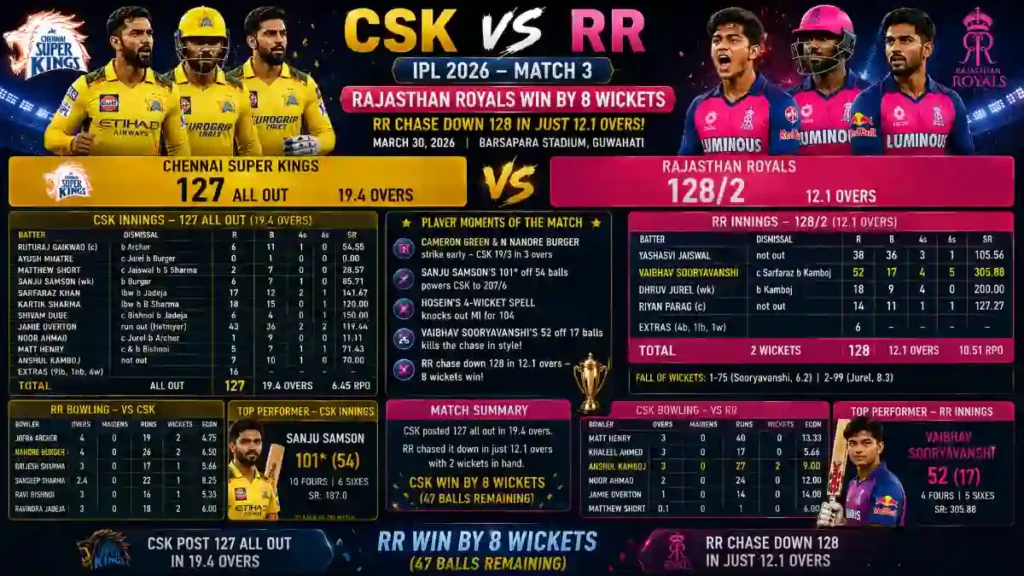

In IPL 2026 Match 3, Rajasthan Royals beat Chennai Super Kings by 8 wickets at Barsapara Cricket Stadium, Guwahati on March 30, 2026. CSK were bowled out for 127 in 19.4 overs. RR chased it down in just 12.1 overs, with Vaibhav Sooryavanshi smashing 52 off 17 balls (SR: 305.88). This was not a close contest. It was a statement.
CSK vs RR IPL 2026 Match 3 Quick Match Summary
| Detail | Info |
| Match | IPL 2026, Match 3 |
| Date | March 30, 2026 |
| Venue | Barsapara Cricket Stadium, Guwahati |
| Toss | RR won, elected to field |
| CSK Score | 127 All Out (19.4 Overs) |
| RR Score | 128/2 (12.1 Overs) |
| Result | Rajasthan Royals won by 8 wickets |
| Player of the Match | Nandre Burger (2/26, 4 Overs) |
CSK vs RR IPL 2026 Full Scorecard
CSK First Innings 127 All Out (19.4 Overs)
Chennai Super Kings were dismissed for 127 at Barsapara Cricket Stadium. The innings never found its footing. Four wickets had already fallen before the sixth over was complete, and the middle order was left playing catch-up from a position of no return.
| Batter | Dismissal | R | B | 4s | 6s | SR |
| Ruturaj Gaikwad (c) | b Archer | 6 | 11 | 1 | 0 | 54.55 |
| Ayush Mhatre | c Jurel b Burger | 0 | 1 | 0 | 0 | 0.00 |
| Matthew Short | c Jaiswal b S Sharma | 2 | 7 | 0 | 0 | 28.57 |
| Sanju Samson (wk) | b Burger | 6 | 7 | 1 | 0 | 85.71 |
| Sarfaraz Khan | lbw b Jadeja | 17 | 12 | 2 | 1 | 141.67 |
| Kartik Sharma | lbw b B Sharma | 18 | 15 | 0 | 1 | 120.00 |
| Shivam Dube | c Bishnoi b Jadeja | 6 | 4 | 0 | 1 | 150.00 |
| Jamie Overton | run out (Hetmyer) | 43 | 36 | 2 | 2 | 119.44 |
| Noor Ahmad | c Jurel b Archer | 1 | 9 | 0 | 0 | 11.11 |
| Matt Henry | c & b Bishnoi | 5 | 7 | 1 | 0 | 71.43 |
| Anshul Kamboj | not out | 7 | 10 | 1 | 0 | 70.00 |
| Extras | (9lb, 1nb, 6w) | 16 | ||||
| Total | All Out | 127 | 19.4 Ov |
Fall of Wickets: 6-1 (Mhatre, 0.4), 14-2 (Gaikwad, 1.6), 19-3 (Samson, 2.6), 38-4 (Short, 5.3), 51-5 (Sarfaraz, 7.2), 57-6 (Dube, 7.6), 74-7 (K Sharma, 10.3), 82-8 (Noor, 12.5), 94-9 (Henry, 15.3), 127-10 (Overton, 19.4)
RR Bowling CSK Innings
| Bowler | O | M | R | W | Econ |
| Jofra Archer | 4 | 0 | 19 | 2 | 4.75 |
| Nandre Burger | 4 | 0 | 26 | 2 | 6.50 |
| Brijesh Sharma | 3 | 0 | 17 | 1 | 5.66 |
| Sandeep Sharma | 2.4 | 0 | 22 | 1 | 8.25 |
| Ravi Bishnoi | 3 | 0 | 16 | 1 | 5.33 |
| Ravindra Jadeja | 3 | 0 | 18 | 2 | 6.00 |
Key stat: Six wickets were shared among three bowlers Archer, Burger, and Jadeja. Every bowler who took a wicket had an economy under 7. That is a disciplined, coordinated bowling effort rarely seen in T20 cricket.
RR Second Innings 128/2 (12.1 Overs)
Rajasthan Royals chased down 128 in just 12.1 overs with 47 balls to spare. The chase was powered by one of the most explosive powerplay performances in recent IPL history.
| Batter | Dismissal | R | B | 4s | 6s | SR |
| Yashasvi Jaiswal | not out | 38 | 36 | 3 | 1 | 105.56 |
| Vaibhav Sooryavanshi | c Sarfaraz b Kamboj | 52 | 17 | 4 | 5 | 305.88 |
| Dhruv Jurel (wk) | b Kamboj | 18 | 9 | 4 | 0 | 200.00 |
| Riyan Parag (c) | not out | 14 | 11 | 1 | 1 | 127.27 |
| Extras | (4b, 1lb, 1w) | 6 | ||||
| Total | 2 wickets | 128 | 12.1 Ov |
Fall of Wickets: 75-1 (Sooryavanshi, 6.2), 99-2 (Jurel, 8.3)
CSK Bowling RR Innings
| Bowler | O | M | R | W | Econ |
| Matt Henry | 3 | 0 | 40 | 0 | 13.33 |
| Khaleel Ahmed | 3 | 0 | 17 | 0 | 5.66 |
| Anshul Kamboj | 3 | 0 | 27 | 2 | 9.00 |
| Noor Ahmad | 2 | 0 | 24 | 0 | 12.00 |
| Jamie Overton | 1 | 0 | 14 | 0 | 14.00 |
| Matthew Short | 0.1 | 0 | 1 | 0 | 6.00 |
Matt Henry’s figures of 0/40 in 3 overs an economy of 13.33 encapsulate CSK’s bowling misery. When your most experienced seamer leaks 40 in 18 balls, the chase becomes a formality.
Advanced Match Statistics Phase-by-Phase Breakdown
This section does what most scorecard pages fail to do it shows not just what happened, but when and why.
Powerplay Comparison (Overs 1–6)
| Metric | CSK | RR |
| Runs Scored | 41 | 75 |
| Wickets Lost | 4 | 1 |
| Run Rate | 6.83 | 12.50 |
| Boundaries | 5 | 14 |
| Dot Balls | ~18 | ~6 |
The powerplay comparison alone tells you everything about this match. RR scored 75 runs in 6 overs while losing one wicket. CSK scored 41 in the same span while losing four. That gap 34 runs and 3 wickets in identical conditions on the same pitch is the match in a single data block.
Phase-by-Phase Run Scoring CSK Innings
| Phase | Overs | Runs | Wickets | Run Rate |
| Powerplay | 1–6 | 41 | 4 | 6.83 |
| Middle Overs | 7–15 | 50 | 5 | 5.56 |
| Death Overs | 16–19.4 | 36 | 1 | ~9.47 |
A key tactical observation: CSK’s death-over performance (36 runs in the final five overs) actually looks competitive on paper. But it was built almost entirely on Jamie Overton’s late cameo from No. 8. That is not a batting plan that is a survival act.
Partnership Summary CSK Innings
| Partnership | Runs | Balls |
| 1st (Gaikwad-Mhatre) | 6 | 4 |
| 2nd (Gaikwad-Short) | 13 | 15 |
| 3rd (Short-Samson) | 0 | 1 |
| 4th (Short-Sarfaraz) | 19 | 16 |
| 5th (Sarfaraz-Dube) | 13 | 8 |
| 6th (Dube-K Sharma) | 6 | 5 |
| 7th (K Sharma-Overton) | 17 | 18 |
| 8th (Overton-Noor) | 8 | 18 |
| 9th (Overton-Henry) | 12 | 10 |
| 10th (Overton-Kamboj) | 33 | 26 |
The 10th wicket partnership of 33 runs between Overton and Kamboj was CSK’s highest partnership of the entire innings. That is not a fluke. That is a systemic structural failure at the top and middle of the order.
Why CSK Collapsed The Real Tactical Breakdown
The Powerplay Was a Graveyard Not a Platform
Most discussions treat CSK’s powerplay collapse as bad luck. A key tactical factor was actually the match-up planning executed by RR captain Riyan Parag. He opened with Archer specifically targeting Ruturaj Gaikwad, who has historically struggled against high-pace seam movement early in an innings. Gaikwad’s 6 off 11 balls before being bowled confirmed the read was correct.
Burger was then deployed from the other end with a different challenge: disciplined away-swing at a fuller length to the right-handers. Mhatre and Samson fell to nearly identical dismissals both pushing at deliveries they did not need to play. This was not sloppy batting. This was elite bowling forcing batters into no-win scenarios.
The Middle-Order Had No Foundation to Build On
When the top four collectively contribute 14 runs, the middle order is not rebuilding it is starting from scratch. Sarfaraz Khan’s 17 off 12 and Kartik Sharma’s 18 off 15 were genuinely good cameos under pressure, but they were cameos in a crisis rather than innings with a platform.
Jadeja’s double-strike removing both Sarfaraz and Dube within two overs of each other in the middle phase was the killing blow. It removed the two batters with the power-hitting ceiling to make 150 a realistic total. Once they fell, the innings was always going to finish under 135.
Analyst’s Take: CSK’s Batting Order Construction Is the Real Problem
The issue is not form. It is architecture. CSK’s batting lineup in this match had seven recognized batters and three lower-order bowlers. But the recognized batters collectively scored 55 runs across seven wickets. A team cannot plug structural holes with individual brilliance repeatedly. This is a squad selection and batting order conversation the CSK management cannot avoid much longer.
Vaibhav Sooryavanshi’s 52 Off 17 Balls A Detailed Breakdown
Shot-by-Shot Approach: Calculated, Not Reckless
The chennai super kings vs rajasthan royals match scorecard will be remembered for years primarily because of this innings. Sooryavanshi’s 52 off 17 balls was the highest-impact powerplay innings of the IPL 2026 season’s opening weekend.
What separated this innings from a typical power-hitter’s blitz was shot selection discipline. He did not swing at everything. The data shows he left or blocked anything on a good length outside off stump during the first two balls of each over then attacked the moment length shifted.
- Four sixes came from full deliveries a deliberate decision to target the slot where fielder placement cannot be pre-emptive
- Four fours came from cut and drive shots off-side width was punished without exception
- His only defensive shot was literally one a block off Khaleel Ahmed in over three
Why He Is Not “Potential” Anymore
At an age when most cricketers are still developing their game at Under-19 level, Sooryavanshi is executing match-winning T20 innings under professional IPL pressure. Potential implies the future. His numbers are present tense. A 305.88 strike rate in a competitive IPL match does not happen by accident or on flat pitches alone Guwahati’s surface offered early morning assistance to bowlers, making his assault even more remarkable.
Nandre Burger Why the Player of the Match Award Was Correct
Early Wickets Change Psychology, Not Just Scorecards
Nandre Burger’s 2/26 in 4 overs does not look dominant at surface level. But in T20 cricket, the timing of wickets matters more than the number of wickets. Burger’s double strike in overs one and three removing both openers before the innings had momentum was a psychological dismantling of CSK’s batting unit.
Every batter who followed those dismissals walked in knowing the team was already 19/3. That knowledge compresses intent, shortens backlift, and changes the decision-making process on every ball. Burger did not just take two wickets. He made every subsequent CSK batter more vulnerable.
A key tactical factor was also the contrast in Burger’s two dismissals. Mhatre was caught in the cordon playing an early push attacking intent punished. Samson was bowled through the gate defensive play punished. Burger was offering no good option. That is elite T20 bowling.
Jofra Archer’s 4-0-19-2 Economy That Controlled a Chase
What 4.75 Economy Means in T20 Context
An economy of 4.75 in T20 cricket is the equivalent of bowling dot balls on demand. For context, a dot-ball economy of 6.00 is considered highly controlled. Archer’s 19 runs across 24 deliveries meant CSK were not only losing wickets they were scoring below the required rate against him every single over.
His dismissal of Gaikwad in the second over of the match with an in-swinger that crashed into the top of off stump set the physical and mental tone. After Gaikwad fell, CSK had no captain, no anchor, and no coherent batting plan all within six balls of the first over.
Ravindra Jadeja’s Quiet, Clinical Role
The Match-Within-the-Match That Nobody Discussed
While Sooryavanshi’s innings and Burger’s powerplay performance dominated post-match conversation, Jadeja’s 2/18 in 3 overs was the tactical insurance that sealed CSK’s fate. His wickets Sarfaraz Khan and Shivam Dube in the middle overs removed the two players most likely to launch a counter-attack between overs seven and fifteen.
Dube, in particular, is widely known as one of IPL’s most destructive hitters against spin bowling. The fact that Jadeja tied him up for 4 balls and then dismissed him for 6 runs tells you how well-set the bowling plan was. This was not opportunistic spin it was a carefully matched phase bowling strategy by captain Parag.
RR vs CSK Head-to-Head Three Straight RR Wins
The chennai super kings vs rajasthan royals match scorecard from IPL 2026 is the third consecutive result in this fixture that has gone RR’s way.
| Match | Season | Venue | Result |
| IPL 2025, Match 11 | 2025 | Guwahati | RR won by 6 runs |
| IPL 2025, Match 62 | 2025 | Delhi | RR won by 6 wickets |
| IPL 2026, Match 3 | 2026 | Guwahati | RR won by 8 wickets |
The margin of victory in each successive match has grown 6 runs, then 6 wickets, then 8 wickets. That is not a trend. That is a pattern of structural dominance. RR have clearly identified how to approach CSK, and they have executed the same template with increasing efficiency each time.
According to match data from ESPNcricinfo and the official Rajasthan Royals website, RR’s formula against CSK has been consistent: dominate the powerplay with the ball, neutralize CSK’s middle-order threats with spin, and back their opening pair to chase down totals aggressively.
What CSK Must Fix Before Their Next Match
This is where the analysis needs to become actionable.
Structural Issues Not Form Issues
- Opening pair problem: The fall of wickets data (19/3 inside 3 overs) points to a top-order trio that is individually talented but collectively incompatible under early pressure
- No powerplay anchor: CSK need a batter who can absorb pace in the first three overs while the aggressive partner takes calculated risks currently no such partnership structure exists
- Strike rotation in middle overs: Between overs 7 and 15, CSK scored just 50 runs for 5 wickets an average of 5.56 per over. In T20 cricket, this is the phase where teams set up their total. CSK failed here completely
- Bowling depth exposed: Matt Henry’s 0/40 in 3 overs reflects a seam attack that had no answer once the pitch dried out. CSK need a pace option with variation rather than raw speed
Read More About – Kolkata Knight Riders vs Mumbai Indians Match Scorecard: Full Scorecard, Turning Points & Tactical Analysis
What RR Got Right A Tactical Lesson
- Toss decision to field read the morning moisture perfectly
- Matched Archer to Gaikwad in the first over a deliberate match-up choice
- Used Jadeja in overs 7–10 targeted the phase where CSK’s middle order was batting
- Backed Sooryavanshi to open trusted young talent in a pressure IPL game and was rewarded immediately
Frequently Asked Questions
Q1: Who won the Chennai Super Kings vs Rajasthan Royals match in IPL 2026 Match 3?
Ans. Rajasthan Royals beat Chennai Super Kings by 8 wickets at Barsapara Cricket Stadium, Guwahati on March 30, 2026. RR chased 128 in just 12.1 overs.
Q2: What was CSK’s total score in the RR vs CSK IPL 2026 Match 3?
Ans. CSK were bowled out for 127 in 19.4 overs. Their top scorer was Jamie Overton with 43 off 36 balls batting at No. 8.
Q3: How did RR win the Chennai Super Kings vs Rajasthan Royals match so quickly?
Ans. RR chased 128 in 12.1 overs powered by Vaibhav Sooryavanshi’s 52 off 17 balls in the powerplay. By the end of over 6, RR were already 75/1, making the result a near-certainty.
Q4: Who was the Player of the Match in CSK vs RR IPL 2026?
Ans. Nandre Burger was awarded Player of the Match for his figures of 2/26 in 4 overs. His twin strikes in the powerplay dismantled CSK’s top order.
Q5: What were Vaibhav Sooryavanshi’s stats in the Chennai Super Kings vs Rajasthan Royals match?
Ans. Sooryavanshi scored 52 off 17 balls 4 fours, 5 sixes, strike rate of 305.88. He was dismissed in the seventh over by Anshul Kamboj, caught by Sarfaraz Khan, but by then the match was effectively over.
Q6: What were Jofra Archer’s bowling figures vs CSK in IPL 2026?
Ans. Archer took 2 wickets for 19 runs in 4 overs at an economy of 4.75. He dismissed Ruturaj Gaikwad in the second over, which proved to be the defining blow of the CSK innings.
Q7: What was CSK’s powerplay score vs RR in Guwahati?
Ans. CSK scored 41/4 in the powerplay. By contrast, RR scored 75/1 in their six powerplay overs a 34-run and 3-wicket differential that decided the match.
Q8: Who top-scored for CSK in the RR vs CSK IPL 2026 Match 3 scorecard?
Ans. Jamie Overton top-scored for CSK with 43 off 36 balls batting at No. 8. His innings included 2 fours and 2 sixes. It was a quality effort in a hopeless cause.
Q9: Where was the CSK vs RR IPL 2026 Match 3 played?
Ans. The match was played at Barsapara Cricket Stadium, Guwahati a venue that has historically assisted swing bowlers in morning conditions, which directly influenced Riyan Parag’s toss decision.
Q10: How many times have RR beaten CSK in their last three IPL meetings?
Ans. RR have won all three of their last IPL meetings against CSK in IPL 2025 Match 11 (by 6 runs), IPL 2025 Match 62 (by 6 wickets), and IPL 2026 Match 3 (by 8 wickets). The winning margin has increased each time.