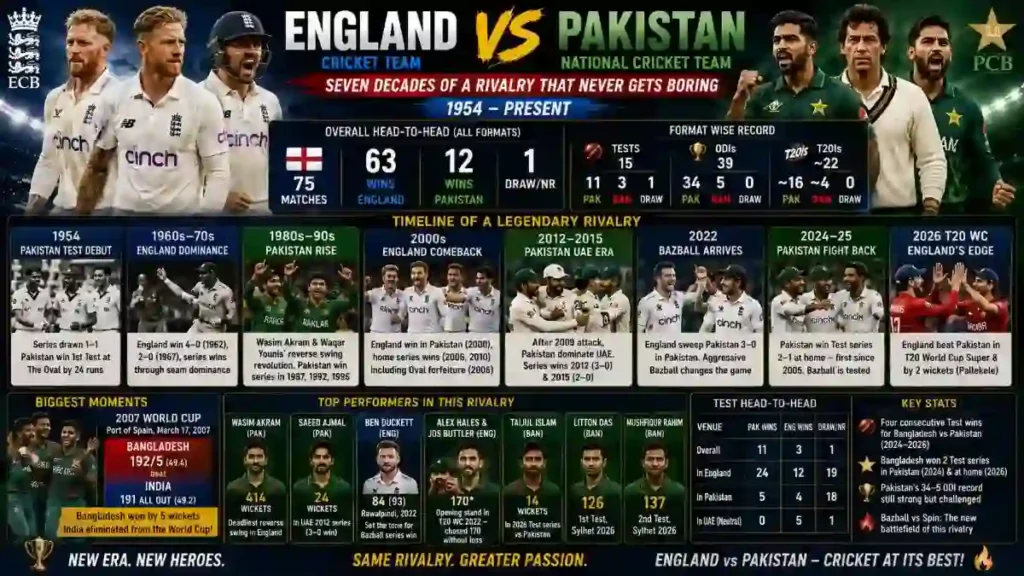

The England vs Pakistan cricket timeline spans from 1954 to the present day. England lead the overall Test head-to-head with 29 wins to Pakistan’s 21, with 38 draws from 88 Tests. The rivalry has shifted era by era from England’s seam dominance in the 1960s, to Pakistan’s reverse swing revolution in the 1990s, to the Bazball era that began in 2022. It remains one of cricket’s most tactically and emotionally contested international rivalries.
It started with a draw at Lord’s in 1954. Pakistan were debutants on English soil. England were a world power. Seventy-two years later, they met again this time in a T20 World Cup Super 8 in Sri Lanka and the match went down to the final over.
That is the beauty of the England Cricket Team Vs Pakistan National Cricket Team Timeline It does not follow a script.
What most fans treat as a simple rivalry is actually something far deeper: a decade-by-decade power shift shaped by pitch politics, bowling revolutions, scandalous moments, and tactical reinvention. This is the full story every major era, every turning point, and every statistic that actually matters.
England vs Pakistan Rivalry Timeline Snapshot
| Era | Dominant Team | Defining Feature |
| 1950s–70s | England | Seam and swing dominance |
| 1980s–90s | Pakistan | Reverse swing revolution |
| 2000–2010 | England | Rebuild and home advantage |
| 2012–2015 | Pakistan | UAE spin masterclass |
| 2022 | England | Bazball’s overseas arrival |
| 2024–25 | Pakistan | Bazball counterattack |
This table alone tells you what most static archive pages never will: this rivalry has no permanent winner.
The Beginning: Pakistan’s Test Debut in England (1954)
England and Pakistan first played Test cricket in 1954. The four-match series ended level one win each and two draws.
Pakistan arrived in England in the summer of 1954 as a nation barely three years old as a Test-playing side. England won the second Test at Trent Bridge by an innings and 129 runs. Pakistan responded by winning the fourth and final Test at The Oval by 24 runs their first-ever Test victory on English soil.
That result was not a fluke. It was a statement. Pakistan could compete at the highest level from day one a founding truth of this entire rivalry that most historical accounts gloss over.
What Most People Miss About 1954
No other team in cricket history won a Test in England during their debut series in their second year of playing Test cricket. Pakistan did. The seeds of genuine competition were planted on a grey August afternoon at The Oval, and they never stopped growing.
England’s Early Dominance: 1954–1978
England dominated the first two decades of this rivalry, winning series consistently on home soil through seam-friendly pitches and superior conditions knowledge.
Through the 1960s and early 1970s, England held clear superiority in the England vs Pakistan Test series history:
- 1962 in England: England won 4–0 in a five-match series
- 1967 in England: England won 2–0
- 1971 in England: England won the series
- 1978 in England: England won 2–0
Pakistan won individual Tests but consistently failed to win series. Their batting was talented but brittle on seaming surfaces. Their bowling, however skilled, lacked the pace and variation needed to consistently trouble English batters on English pitches.
The Tactical Reality of the 1960s
England exploited conditions ruthlessly. Bowlers like Derek Underwood operated on pitches where Pakistani batters accustomed to flat subcontinental surfaces struggled to read lateral movement. This was not a talent failure. It was a conditions intelligence gap that took Pakistan a generation to close.
Pakistan’s Rise: The Reverse Swing Revolution (1980s–1990s)
Pakistan’s greatest era against England came in the late 1980s and 1990s, driven by the reverse swing of Wasim Akram and Waqar Younis. They won series in 1987, 1992, and 1996.
The England Cricket Team Vs Pakistan National Cricket Team Timeline shifted fundamentally in this decade. The 1982 series was a preview England won 2–1, but the scoreline flattered them. Pakistan’s 10-wicket win at Lord’s in that series, despite following on, showed a new psychological steel in the team.
Then came the turning point years:
- 1987: Pakistan, under Imran Khan, won the series in England
- 1992: Wasim Akram and Waqar Younis destroyed England with reverse swing. Pakistan won the series
- 1996: Waqar and Wasim again dismantled England at Lord’s. Pakistan won again
In 14 Tests between 1987 and 1996, Pakistan won 7, England won 4, and 3 were drawn. England had no answer to the old ball behaving like a new one.
Why England Could Not Solve Reverse Swing
The 1990s Pakistan attack Wasim Akram, Waqar Younis, Mushtaq Ahmed, and Saqlain Mushtaq was arguably the most diverse bowling arsenal any visiting team had ever brought to England. Four completely different threats, each requiring a different technical response. England did not just lose those series. They were outthought. Their batting coaches had no coaching manuals for this. There were none to write yet.
This is where things genuinely went wrong for England: reverse swing was not just a skill. It was a philosophical weapon. It rewrote what fast bowling meant. Pakistan owned it for a decade.
The England Comeback: 2000–2010
England regained dominance in the 2000s, winning series in Pakistan (2000), and in England (2006 and 2010), including a historic forfeiture win at The Oval in 2006.
England gradually rebuilt their red-ball identity through the 2000s:
- 2000 in Pakistan: England won the series 1–0
- 2006 in England: England won 3–0
- 2010 in England: England won 3–1
The 2006 series produced one of cricket’s most extraordinary moments. At The Oval, Pakistan refused to take the field after umpires penalized them for alleged ball-tampering. The match was awarded to England by forfeiture the only time in Test history a team has lost a match this way. The decision was later reversed by the ICC before being reinstated, creating years of legal and administrative controversy.
The Problem With England’s Confidence in This Era
England were winning, but context matters. They were beating a Pakistan team in transition one without the dominant reverse-swing threat of the 1990s. When Pakistan rebuilt with Saeed Ajmal’s off-spin variations and Younis Khan’s batting pedigree, the equation shifted again dramatically.
The UAE Era: Pakistan’s Home Advantage in Exile (2012–2015)
After a terrorist attack on the Sri Lanka team bus in Lahore in 2009, Pakistan moved their home Tests to the UAE. They dominated England there winning 3–0 in 2012 and 2–0 in 2015.
The England Pakistan UAE Test series is the most misunderstood chapter in this rivalry. Most cricket fans assume the UAE was neutral ground. It was not.
The pitches in Dubai and Abu Dhabi were specifically prepared for Pakistan’s spinners:
- 2012: Saeed Ajmal returned match-winning figures across three Tests. Pakistan won 3–0
- 2015: Yasir Shah dominated with leg-spin. Pakistan won 2–0
England averaged under 24 per wicket against Saeed Ajmal in the 2012 series, repeatedly failing to handle off-spin combined with doosra variations on wearing surfaces. Their preparation was technically inadequate. They had no specialist plan for spin on pitches that spun from day one.
What People Think vs Reality: The UAE
The popular narrative says Pakistan had no home advantage in the UAE. The data says the opposite. In six Tests at neutral venues against England, Pakistan won five and drew one. The conditions were never neutral. They were engineered. That is smart cricket, not luck.
The 2010 Spot-Fixing Scandal: Cricket’s Darkest Chapter
During the 2010 Lord’s Test, three Pakistan players Salman Butt, Mohammad Asif, and Mohammad Amir were found guilty of deliberately bowling no-balls as part of a spot-fixing arrangement. All three were banned.
The 2010 Lord’s Test sits awkwardly in the England Cricket Team Vs Pakistan National Cricket Team Timeline. England won by an innings and 225 runs one of their biggest margins against Pakistan. But the victory was overshadowed entirely.
All three players received bans. Salman Butt and Mohammad Asif received five-year bans. Mohammad Amir received a five-year ban at just 18 years of age.
Mohammad Amir’s Redemption
What makes this episode genuinely tragic and ultimately hopeful is what came next. Amir returned to international cricket in 2016, matured and technically sharper. He became one of Pakistan’s finest left-arm pacers of the modern era, producing memorable performances in Test matches and white-ball cricket alike. His story is one of sport’s genuine second-chance narratives. It does not erase what happened. But it adds necessary complexity to the story.
Bazball Arrives: England Sweep Pakistan 3–0 in 2022
In December 2022, England toured Pakistan for the first time in 17 years and won 3–0 under captain Ben Stokes and coach Brendon McCullum, playing attacking, high-tempo Test cricket now known as Bazball.
This is the most significant chapter in the modern England Cricket Team Vs Pakistan National Cricket Team Timeline. England arrived in Pakistan without having won a Test series there since 2000. They left having won all three Tests.
- First Test, Rawalpindi: England won by 74 runs after scoring 657 in their first innings
- Second Test, Multan: England won by 26 runs
- Third Test, Karachi: England won by 8 wickets
England scored at over 4.5 runs per over in their first innings in Rawalpindi. Pakistan’s bowlers conditioned to bowl tight lines, restrict scoring, and wait for errors had no Plan B. The game was being played at a tempo they had never experienced in a Test match on their own soil.
Why Bazball Worked in Pakistan: The Tactical Breakdown
- Aggressive scoring neutralized spin deterioration England batted before pitches became difficult
- High strike rates forced defensive field placements Pakistan’s bowlers lost control of the game plan
- Mental disruption Pakistani bowlers could not settle into rhythm or build pressure
- Scoring before the pitch turned England took the game out of Pakistan’s spinner-friendly hands on day one
Every pre-series analyst said England could not win in Pakistan with aggressive batting. They won every single Test. The lesson is not that Bazball always works. The lesson is that aggressive intent, executed with precision, can be more disorienting than conventional defence especially when no one has seen it applied at this level before.
Pakistan Strike Back: The 2024–25 Test Series
Pakistan won the 2024–25 Test series against England 2–1, their first home series win against England since 2005. It proved that Bazball is not invincible.
England returned to Pakistan in October 2024. This time, Pakistan were prepared.
- First Test, Multan: Pakistan won on a pitch prepared to turn from day one
- Second Test, Multan: Pakistan won again England’s batters exposed by relentless spin
- Third Test, Rawalpindi: England won showing Bazball still has teeth on flatter surfaces
Pakistan’s margin was decisive: 2–1. They had studied the 2022 series, identified the conditions England struggled in turning pitches, slow over rates, sustained spin and engineered exactly that.
The Counterintuitive Truth About Bazball
Bazball is not a permanent weapon. It is a philosophy that works best when conditions allow aggressive batting. When Pakistan removed those conditions by preparing surfaces that deteriorated quickly and brought their best spinners into play England’s tempo-based game became a liability rather than an asset. This is not a failure of Bazball. It is proof the rivalry is genuinely balanced.
The T20 Chapter: England’s World Cup Dominance Over Pakistan
England have beaten Pakistan in back-to-back T20 World Cups by 10 wickets in Melbourne in 2022 and by 2 wickets at Pallekele in 2026.
The England Pakistan T20 World Cup record is one of the most discussed sub-stories in this rivalry. Two meetings. Two England wins. Both in knockout situations.
- T20 World Cup 2022, Melbourne: Pakistan set 169. England chased it without losing a wicket. Alex Hales (86*) and Jos Buttler (80*) put on 170 for the first wicket the most clinical T20 chase in World Cup history
- T20 World Cup 2026, Pallekele (Super 8): Pakistan posted 164/9. England finished on 166/8 winning by 2 wickets off the final ball
England have now beaten Pakistan in every T20 World Cup knockout encounter they have played. Pakistan’s batting collapses under pressure in T20 knockout cricket remain a recurring pattern that coaching staff have not yet solved.
Head-to-Head Records: The Full Picture
| Format | Played | England Wins | Pakistan Wins | Drawn/No Result |
| Tests (Overall) | 88 | 29 | 21 | 38 |
| Tests in England | 55 | 24 | 12 | 19 |
| Tests in Pakistan | 27 | 5 | 4 | 18 |
| Tests at Neutral (UAE) | 6 | 0 | 5 | 1 |
The most important number in this table is not the overall record. It is the neutral venue record. Pakistan won 5 out of 6 Tests in the UAE against England. England have won 24 out of 55 Tests in England. Home advantage or manufactured home advantage is almost determinative in this rivalry.
Greatest Individual Performances in This Rivalry
These performances did not just win matches. They defined entire eras.
- Wasim Akram, Lord’s 1992: His reverse swing destroyed England’s middle order to seal a 2-wicket win. The birth of Pakistan’s bowling supremacy in England
- Saeed Ajmal, UAE 2012: Took 24 wickets across the three-Test series. England’s batting lineup had no answer for his doosra and off-break combination
- Ben Duckett, Rawalpindi 2022: His 84 off 93 balls in the first innings set the attacking tone that defined the entire Bazball series in Pakistan
- Alex Hales + Jos Buttler, Melbourne 2022: Chased 170 without a wicket falling. Perhaps the cleanest T20 World Cup knockout chase in the format’s history
- Yasir Shah, UAE 2015: Took 19 wickets in the series against England announcing himself as Pakistan’s next great spin weapon
Read More About – Bangladesh National Cricket Team Vs Afghanistan National Cricket Team Timeline: The Rivalry That Cricket Didn’t See Coming
Major Series Results Timeline
| Year | Venue | Winner | Margin |
| 1954 | England | Level (1–1) | — |
| 1962 | England | England | 4–0 |
| 1987 | England | Pakistan | 1–0 |
| 1992 | England | Pakistan | 2–1 |
| 1996 | England | Pakistan | 2–0 |
| 2000 | Pakistan | England | 1–0 |
| 2006 | England | England | 3–0 |
| 2010 | England | England | 3–1 |
| 2012 | UAE | Pakistan | 3–0 |
| 2015 | UAE | Pakistan | 2–0 |
| 2022 | Pakistan | England | 3–0 |
| 2024–25 | Pakistan | Pakistan | 2–1 |
The Rivalry Today: What Comes Next
Both teams are in active transition. England’s Bazball has now won and lost overseas series which means it is no longer a surprise tactic but a tested identity that opponents understand and prepare for. Pakistan are rebuilding their red-ball squad with emerging pace bowlers alongside experienced spinners.
The 2026 T20 World Cup encounter at Pallekele confirmed England’s white-ball edge. But the next full Test series in Pakistan will test whether the Bazball era can survive a Pakistan team that has now beaten it at home.England currently hold the tactical advantage across formats. But Pakistan’s history of producing generational bowling talent Imran Khan to Wasim Akram to Waqar Younis to Shoaib Akhtar to Mohammad Amir is the most powerful wildcard in cricket. This rivalry shifts the moment Pakistan find their next great bowler. That bowler is already somewhere in the domestic system. When he arrives, the next era of the England vs Pakistan cricket timeline begins.
Frequently Asked Questions
Q1. When did England and Pakistan first play a Test match?
Ans. England and Pakistan first played a Test match at Lord’s in June 1954. The match ended in a draw. Pakistan went on to win the final Test of the series at The Oval by 24 runs their first-ever Test victory on English soil.
Q2. Who leads the England vs Pakistan head-to-head Test record?
Ans. England lead the overall Test head-to-head: 29 wins to Pakistan’s 21, with 38 draws from 88 Tests. However, Pakistan have won 5 out of 6 Tests at neutral venues, making the record highly context-dependent.
Q3. Why did Pakistan play home Tests in the UAE?
Ans. Following a terrorist attack on the Sri Lanka cricket team bus in Lahore in March 2009, Pakistan could not safely host international teams. They used Dubai and Abu Dhabi as a base for home Tests from 2009 to 2022, when they returned to hosting in Pakistan.
Q4. What is Bazball and how did it affect Pakistan?
Ans. Bazball refers to England’s aggressive, high-tempo Test batting approach introduced under captain Ben Stokes and coach Brendon McCullum. In 2022, it produced a historic 3–0 series win in Pakistan. Pakistan reversed the result 2–1 in 2024–25 by preparing turning pitches that neutralised England’s attacking approach.
Q5. What happened at The Oval in the 2006 Test between England and Pakistan?
Ans. Pakistan refused to return to the field after umpires penalised them for alleged ball-tampering on the match ball. The Test was awarded to England by forfeiture the only time in Test history a match has been decided this way. The decision sparked years of controversy and ICC review.
Q6. Who has the best bowling record in England vs Pakistan Tests?
Ans. Wasim Akram tops the list for Pakistan with 68 career Test wickets against England. Saeed Ajmal and Yasir Shah dominated in the UAE era. For England, Derek Underwood, Bob Willis, and more recently James Anderson have been the most impactful bowlers against Pakistan.
Q7. Did Pakistan win the 2022 T20 World Cup semi-final against England?
Ans. No. England beat Pakistan by 10 wickets in Melbourne chasing 169 without losing a wicket. Alex Hales (86*) and Jos Buttler (80*) completed the chase in the 19th over in what remains one of the most dominant knockout performances in T20 World Cup history.
Q8. What was the result of England vs Pakistan at the T20 World Cup 2026?
Ans. England beat Pakistan by 2 wickets in the Super 8 stage at Pallekele, Sri Lanka. Pakistan posted 164/9, and England chased it down finishing on 166/8 off the final ball a second consecutive T20 World Cup win over Pakistan.
Q9. How many times has Pakistan beaten England in England in Tests?
Ans. Pakistan have won 12 Tests on English soil out of 55 played, compared to England’s 24 wins. Their most dominant decade in England was the 1990s winning series in 1987, 1992, and 1996 through their reverse swing revolution.
Q10. What is the biggest winning margin in England vs Pakistan Tests?
Ans. England’s win by 354 runs at Trent Bridge in 2010 stands as one of the largest margins in this rivalry. For Pakistan’s biggest wins, their 1996 series victories included a dominant innings win at Lord’s. The 2022 Rawalpindi Test, where England scored 657 and won by 74 runs, is considered among the most tactically consequential matches in the rivalry’s modern history.