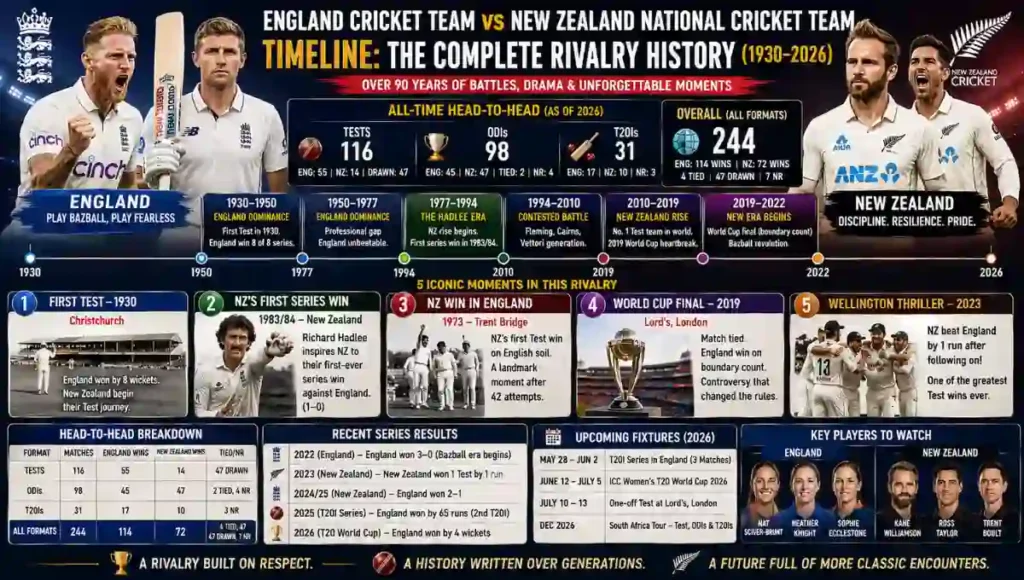

The England cricket team vs New Zealand national cricket team timeline spans over 90 years, beginning with their first Test in Christchurch in January 1930. England dominated for five decades before New Zealand’s historic first series win in 1983/84. The rivalry’s modern peak came at the 2019 World Cup Final decided by boundary count and continues today with England’s Bazball era reshaping the contest across all formats. As of 2026, England lead the all-format head-to-head with 114 wins from 244 completed matches, while New Zealand have won 72.
England had beaten New Zealand in 20 consecutive series before New Zealand won their first. That was 1983. It took half a century.
That is not just a statistic. It is the story of two teams on opposite ends of a long, slow power shift one that is still unfolding today. The England cricket team vs New Zealand national cricket team timeline is one of cricket’s most underrated rivalries: built on institutional gaps, individual genius, a World Cup final that broke all the rules, and a tactical revolution called Bazball.
Quick Stats: England vs New Zealand At a Glance
| Format | Matches | England Wins | NZ Wins | Tied/NR |
| Tests | 116 | 55 | 14 | 47 draws |
| ODIs | 96 | 45 | 45 | 2 tied, 4 NR |
| T20Is | 31 | 17–18 | 10 | 3 NR |
| All Formats | 244 | 114 | 72 | 4 tied, 47 draws, 7 NR |
How the Rivalry Began: 1930–1950
The First Test and What It Really Meant
The first Test between England and New Zealand was played in Christchurch in January 1930. England won by 8 wickets. New Zealand scored 112 and 131 against an England side already regarded as the world’s dominant cricket force.
What most people miss is that New Zealand had no professional cricket infrastructure at the time. They were essentially a touring side made up of club players facing a seasoned international machine. In the context of the England cricket team vs New Zealand national cricket team timeline, drawing three of four Tests on that 1929-30 tour was, quietly, a remarkable result for New Zealand.
The Post-War Gap
England played New Zealand at home for the first time in 1931 and dominated again. Between 1930 and 1950, not a single series was won by New Zealand. Eight series. Zero wins.
But here is what most people miss: New Zealand were not simply bad. They were simultaneously building domestic cricket from scratch, developing player depth, and surviving as a cricket board with almost no financial support. England were 50 years ahead institutionally. The 1946/47 tour produced just one Test drawn partly because post-World War II travel made full tours logistically impossible. The rivalry stalled not just because of talent gaps, but because of geography, economics, and colonial cricket politics.
The Era of English Dominance: 1950–1977
England Win Everything But the Numbers Lie
From 1950/51 through the 1970s, England won almost every series. The 1954/55 tour ended 2-0. The 1962/63 series in New Zealand ended 3-0. The 1965 series at home? England won 3-0.
This is where the all-time head-to-head numbers were built. England’s 55 Test wins to New Zealand’s 14 were almost entirely accumulated during this 25-year period of structural inequality, not competitive cricket.
The Part-Time Cricketers Nobody Talks About
Here is the insight that almost every article covering the England cricket team vs New Zealand national cricket team timeline skips: New Zealand players in this era were effectively part-time cricketers. Most held day jobs. When Richard Hadlee later said he wanted to “make New Zealand a professional cricket country,” this 1950–70s era is exactly the reality he was reacting against.
New Zealand’s First Win on English Soil
The 1973 series was a turning point. England won 2-1, but New Zealand earned their first-ever Test win in England at Trent Bridge their first victory against England in 42 attempts. That win passed with little fanfare in the British press. In New Zealand, it was a national moment. The power gap was beginning very slowly to close.
Richard Hadlee Changes Everything: 1977–1990
The Man Who Rewrote the Rivalry
If there is one player who permanently altered the England cricket team vs New Zealand national cricket team timeline, it is Sir Richard Hadlee. In 86 Tests, Hadlee took 431 wickets at an average of 22.29 and at the time of his retirement, it was the world record.
New Zealand’s First Series Win Against England
The 1983/84 series in New Zealand was the first time New Zealand won a series against England 1-0. Hadlee was relentless. He did not just take wickets; he dismantled batting orders through intelligent seam bowling that combined raw pace with obsessive line-and-length discipline.
What People Think vs Reality
People assume Hadlee was simply a fast bowler who thrived on English green-tops. That is wrong. Hadlee studied English and overseas conditions obsessively. He targeted what became known as the “corridor of uncertainty” before that phrase was even in common cricket vocabulary. His mastery was technical and psychological, not just physical.
In the 1986 series in England, New Zealand won again. Back-to-back series wins against England something no one had thought possible a decade earlier.
The Parity Scorecard
In the 11 series between 1977 and 1994, New Zealand won 3, England won 4, and 4 were drawn. The era of automatic English dominance in the England vs New Zealand cricket rivalry was over for good.
The 1990s and 2000s: Genuine Competition
New Zealand Build a Real Test Side
The 1999 series was a landmark: New Zealand won 2-1 in England. Glenn Turner’s generation had given way to players like Chris Cairns, Stephen Fleming, and Daniel Vettori. New Zealand were no longer a side that occasionally upset England they were a consistent threat.
The 2004 Series Nobody Analyses Properly
Here is something almost no article on the England cricket team vs New Zealand national cricket team timeline discusses: England won the 2004 series 3-0, but the margins were tight throughout. Michael Vaughan later described New Zealand as the toughest opposition England faced that entire summer. Three wins none comfortable. That is the quiet story of how competitive this rivalry had become.
The Counterintuitive Truth About the Head-to-Head
England’s overall head-to-head record flatters them badly. Strip out the pre-1970 era of structural English dominance, and the post-1977 head-to-head is almost level. Since 1977, New Zealand have been a genuinely competitive side in this contest and in ODIs, the rivalry has reached exact parity, with both sides winning 45 matches each.
The 2019 World Cup Final: The Most Controversial Match in Cricket History
A Final That Changed the Rules
On July 14, 2019, at Lord’s, cricket witnessed something it had never seen. England and New Zealand both scored 241 in their 50 overs. The Super Over was tied. England were awarded the World Cup by boundary count 22 fours and 2 sixes versus New Zealand’s 14 fours and 2 sixes.
This is the single most defining moment in the modern England cricket team vs New Zealand national cricket team timeline not merely because it was an extraordinary match, but because of what it exposed about the sport’s governance.
The Tactical Breakdown
New Zealand, led by Kane Williamson, showed composure under impossible pressure. Trent Boult removed Jos Buttler early in the Super Over. Guptill’s desperate attempt to level the scores off the final ball resulted in a run-out but a deflection off Ben Stokes meant England were awarded two overthrow runs in the 49th over, a decision that remains debated. England won the Cup they had chased for 44 years. New Zealand lost through a rule that had never been applied in a final before.
The Structural Injustice and the ICC’s Response
The ICC scrapped the boundary count rule in October 2019 less than three months after the final. From that point, Super Overs in knockout matches would be repeated until one team scored more. The speed of that rule change was the ICC’s indirect acknowledgment that the outcome had been deeply unfair. Losing the 2019 final on boundary count was not a New Zealand failure. It was a structural problem that the governing body quietly fixed.
The 2021–2022 Shift: Bazball Arrives and Rewrites the Contest
New Zealand Win the WTC and Then Get Swept 3-0
In June 2021, New Zealand beat England 1-0 in a two-Test series at Lord’s as newly crowned ICC World Test Championship winners. Joe Root’s England were brittle, inconsistent, and directionless.
Then came June 2022. Ben Stokes took over as England captain. Brendon McCullum became head coach. Bazball was born.
The 3-0 Sweep That Sent a Message
England swept New Zealand 3-0 at home. Jonny Bairstow scored centuries at extraordinary speed. Joe Root was imperious. At Headingley, England chased down 299 in 15.2 overs after a rain delay a batting performance that redefined what Test cricket could look like.
The 2022 series was not just a 3-0 result. It was a philosophical statement. England declared: the old way of cautious, session-based Test cricket was finished. New Zealand, built on disciplined, process-driven cricket, had no prepared answer for England’s deliberate aggression.
But here is the real problem for England: that aggression is not always consistent and New Zealand understood that before England did.
2023 Wellington: When New Zealand Wrote History
The One-Run Masterpiece
In February 2023, England arrived in Wellington as the world’s most dangerous Test team. They lost by one run.
New Zealand became only the fourth team in Test history to win a match after following on. Neil Wagner bowled with relentless aggression. Ben Stokes and Joe Root added a century partnership in the fourth innings. It still was not enough. England’s last wicket fell one run short.
The Tactical Masterclass Behind the Result
The Wellington Test exposed the single structural flaw in Bazball: it works best on pitches that reward stroke-play and pace. On a surface that deteriorates and assists movement in the fourth innings, England’s attacking approach leaves them exposed. New Zealand’s decision to enforce the follow-on was a masterclass in reading conditions and opposition psychology exactly the kind of tactical intelligence that defines the best moments in the England cricket team vs New Zealand national cricket team timeline.
2024/25 and 2025/26: The Modern Chapter of the Rivalry
England Reclaim Their Edge
England toured New Zealand in late 2024 and won the series 2-1, reclaiming their edge after the Wellington defeat. The series confirmed that Bazball, when applied with adaptability, remained highly effective even in New Zealand conditions.
The 2025/26 T20 Series
In October 2025, England returned for a T20 and ODI series. In the 2nd T20I at Christchurch, Phil Salt scored 85 and Harry Brook made 78 as England won by 65 runs one of their most dominant white-ball performances of the year. Adil Rashid took 4 for 32 in that match, underlining England’s all-round depth. New Zealand won the ODI series 1-0, showing that the white-ball contest remains genuinely competitive.
T20 World Cup 2026: England Edge a Thriller
At the T20 World Cup 2026 Super Eights in Colombo, England beat New Zealand by 4 wickets with 3 balls to spare in a tight chase of 160, with Adil Rashid again the key bowling figure. The England cricket team vs New Zealand national cricket team timeline continues to produce high-stakes moments and the T20 format has become its newest frontier.
Read More About – India Women Cricket Schedule 2026: Complete Fixtures, Match Dates, Squads & T20 World Cup Guide
Decade-by-Decade Power Map
| Era | Dominant Side | Key Factor |
| 1930–1950 | England | Institutional and professional gap |
| 1950–1977 | England | Player depth, full-time professionalism |
| 1977–1994 | Contested | Richard Hadlee era, NZ structural rise |
| 1994–2010 | Contested | Fleming, Cairns, Vettori generation |
| 2010–2019 | New Zealand | ICC Test rankings, WTC credibility |
| 2019–2022 | Contested | World Cup Final controversy, Bazball emergence |
| 2022–2026 | Contested | Bazball vs NZ tactical discipline |
Head-to-Head Records: All Formats Updated
Tests
- Total Tests: 116
- England wins: 55 | New Zealand wins: 14 | Drawn: 47
- New Zealand’s first-ever Test win came on February 15, 1978, at Wellington
ODIs
- Total ODIs: 98 matches played
- England 45 wins | New Zealand 47 wins New Zealand now lead the ODI head-to-head
- The ODI format is the only format where New Zealand hold the overall lead
T20Is
- Total T20Is: 31
- England wins: 17 | New Zealand wins: 10 | NR: 3
England lead T20Is comfortably, but New Zealand have won 2 of the last 6 completed matches, showing increasing competitiveness
Frequently Asked Questions
Q1. When did England first play New Zealand in a Test match?
Ans. The first Test in the England cricket team vs New Zealand national cricket team timeline was played in Christchurch on January 10–13, 1930. England won by 8 wickets.
Q2. When did New Zealand first beat England in a Test match?
Ans. New Zealand won their first Test against England on February 15, 1978, at Wellington after 48 years of attempts.
Q3. When did New Zealand first win a series against England?
Ans. New Zealand won their first series against England in 1983/84, winning 1-0 in New Zealand. It was the first series win after over 50 years of attempts.
Q4. What happened in the 2019 World Cup Final between England and New Zealand?
Ans. Both teams scored 241 in 50 overs. The Super Over was tied. England were declared champions by boundary count 26 to New Zealand’s 17. The ICC scrapped the boundary count rule three months later.
Q5. What is Bazball and how did it affect the England vs New Zealand rivalry?
Ans. Bazball is England’s aggressive Test strategy under captain Ben Stokes and coach Brendon McCullum, introduced in 2022. England swept New Zealand 3-0 at home in 2022 using this philosophy, though New Zealand won by one run in Wellington in 2023, exposing its limits on deteriorating pitches.
Q6. Did New Zealand ever win a Test after following on against England?
Ans. Yes. In February 2023 at Wellington, New Zealand won by one run after following on becoming only the fourth team in Test history to win a match after following on.
Q7. How many Tests have England and New Zealand played in total?
Ans. As of 2025, England and New Zealand have played 116 Tests, with England winning 55, New Zealand winning 14, and 47 draws.
Q8. Who is the most influential player in England vs New Zealand Test history?
Ans. Sir Richard Hadlee is the most influential player in this rivalry. His 431 Test wickets (at the time a world record) and back-to-back series wins against England in 1983/84 and 1986 permanently shifted the balance of power.
Q9. Who leads the ODI head-to-head between England and New Zealand?
Ans. As of 2026, New Zealand lead the ODI head-to-head with 47 wins to England’s 45 from 98 completed ODI matches the only format where New Zealand hold the overall lead.
Q10. What was the result of England vs New Zealand at T20 World Cup 2026?
Ans. In the Super Eights at the R. Premadasa Stadium, Colombo, England beat New Zealand by 4 wickets with 3 balls to spare, chasing 160. Adil Rashid was England’s key performer with the ball.