
In February 2026, a cricket team from a country with no rivers, no grassy outfields, and no cricketing tradition stretching back centuries walked out at the MA Chidambaram Stadium in Chennai one of the most iconic venues in the sport and posted 173 runs against New Zealand. They did not win that match. But they made the world notice.
The United Arab Emirates national cricket team is no longer a footnote in world cricket. It is a case study in how a nation can build competitive cricket from scratch through infrastructure, franchise exposure, and sheer institutional will.
Who Governs UAE Cricket
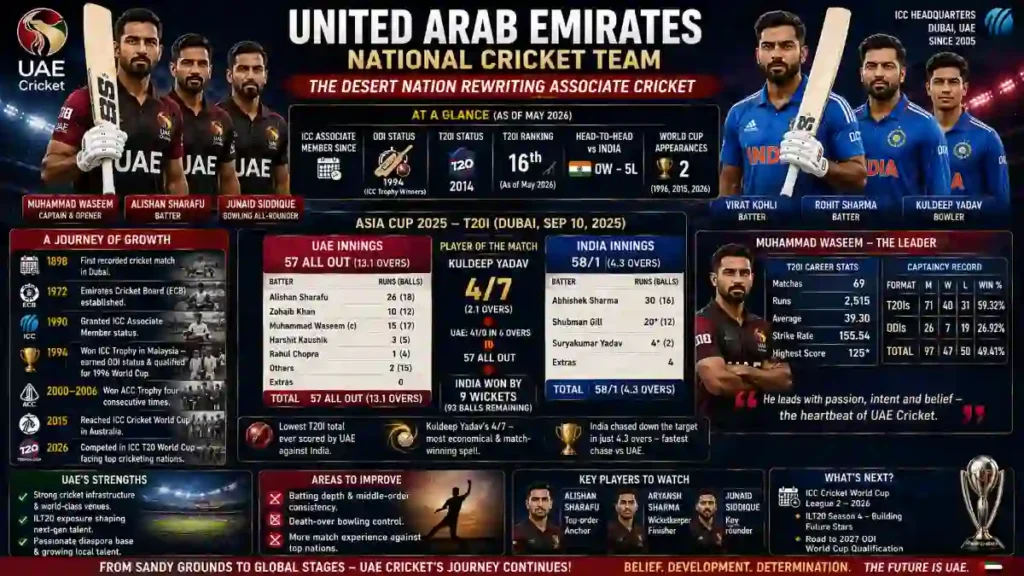
The Emirates Cricket Board (ECB) is the sole governing authority for cricket in the UAE, overseeing the four regional councils of Abu Dhabi, Ajman, Dubai, and Sharjah. The ECB became an Affiliate Member of the ICC in 1989 and was elevated to full Associate Member status in 1990.
Here is what most people miss: the UAE is not just a team that plays cricket it is simultaneously cricket’s most important administrative hub. Since 2005, the ICC’s own global headquarters have been located in Dubai. No other Associate nation in the world carries that dual weight player and power broker at the same time.
The Governance Structure
- Emirates Cricket Board governing and administrative authority
- Four regional councils Abu Dhabi, Ajman, Dubai, Sharjah
- ICC Associate Member full membership since 1990
- ICC HQ location Dubai, UAE since 2005
This governance infrastructure directly benefits the UAE cricket team through access to funding, high-quality venues, ICC development programs, and exposure to elite international cricket that most Associate nations can only dream of.
A Brief History of UAE Cricket
The roots of cricket in the UAE stretch back to 1898, when the first recorded match was played in Dubai. For the first eighty years, the sport existed as a pastime for British expatriates and colonial workers informal, unstructured, and invisible to the world.
That changed in 1981, when philanthropist Abdul Rahman Bukhatir introduced the Cricketers Benefit Fund Series in Sharjah. His vision attracted international teams, built one of cricket’s most iconic venues, and put the UAE on the global cricketing map as a host, not yet as a competitor.
The Foundation Years (1898–1993)
- First recorded match in Dubai: 1898
- Emirates Cricket Board formally established: 1972
- Sharjah Cricket Stadium inaugurated: 1982
- First international series hosted at Sharjah: 1984
For nearly a century, the UAE was more famous as a cricket venue than as a cricket team. The country built the infrastructure before it built the team a sequence that would later prove to be a strategic masterstroke.
The 1994 ICC Trophy: The Shock Heard Across Associate Cricket
At the ICC Trophy 1994, the United Arab Emirates national cricket team did something no one anticipated: they won the entire tournament. The victory was not lucky it was earned through a disciplined campaign against nations with far longer cricketing histories.
The win granted UAE their first ODI status and a direct berth at the 1996 Cricket World Cup in the Indian subcontinent their debut appearance at the sport’s biggest stage.
That ICC Trophy win remains one of the most underappreciated moments in Associate cricket history. It was the result of a cricketing culture being quietly built by an expat-heavy population players from Pakistan, India, and Sri Lanka who had made the UAE their home and brought the sport with them.
From 1996 to 2015: A Long Qualifying Cycle
After the 1996 World Cup, UAE entered a prolonged qualifying cycle. The highlights:
- ACC Trophy wins: Four consecutive titles between 2000 and 2006
- ACC Trophy runner-up: Three times (1996, 1998, 2008)
- 2014: Qualified for the ICC Men’s T20 World Cup and received ODI status
- 2015: Second Cricket World Cup appearance, in Australia all matches lost, but global experience gained
The 2015 World Cup campaign was sobering. But it reinforced something critical: UAE belonged in these conversations. Nearly two decades after their first World Cup, they were back and they were not going away.
UAE as Asia’s Most Important Cricket Hub
This is where the UAE national cricket team’s story becomes genuinely unique in world cricket. While the national side was grinding through qualifiers, the country was simultaneously becoming the most important neutral venue in Asian cricket.
Between 2018 and 2025, the UAE hosted:
- The Asia Cup in 2018, 2022, and 2025
- The ICC Men’s T20 World Cup in 2021
- The ICC Women’s T20 World Cup in 2024
- Afghanistan’s home internationals with a five-year hosting agreement signed in 2025
What People Think vs. Reality
What people think: The UAE national team benefits from playing at home venues against weaker opposition.
Reality: UAE’s players train and compete on the same pitches that India, Pakistan, Afghanistan, and top Test nations use week after week. Sheikh Zayed Stadium in Abu Dhabi and the Dubai International Cricket Stadium are not second-tier facilities they are among the best-maintained venues in world cricket. That environment accelerates development faster than any qualifying tournament ever could.
The structural exposure that comes from hosting elite cricket is UAE’s most underrated developmental asset.
The ILT20 Effect: The Real Game-Changer
Perhaps the single biggest factor in the recent rise of the UAE national cricket team is one that most generic competitor articles ignore entirely: the DP World International League T20 (ILT20).
Launched in 2023, the ILT20 placed UAE-based franchise cricket alongside the BBL, SA20, and CPL as a legitimate global T20 property. More importantly, it gave UAE local players direct access to international superstars, professional coaching staff, and high-pressure franchise environments on a regular basis.
How the ILT20 Pipeline Works
| Stage | Benefit to UAE Players |
| Franchise training camps | Exposure to international coaching methodology |
| Playing alongside global stars | Tactical absorption under pressure |
| High-tempo match environment | Strike rate and death-over skills development |
| Broadcast exposure | Mental conditioning for big-match situations |
| Contract earnings | Financial stability to pursue cricket full-time |
By the time of the T20 World Cup 2026, this influence was no longer theoretical it was visible in scoreboards. Muhammad Waseem, who plays for MI Emirates in the ILT20, carries a T20I strike rate of 150.96 and a batting average of 36.25. Those are not Associate-level numbers. Those are numbers that would earn respect in any franchise league on the planet.
This is not a feel-good narrative. It is a structural reality: the ILT20 has compressed UAE’s development timeline by years.
Muhammad Waseem: The Captain Carrying a Nation
If you want to understand the UAE national cricket team in 2026, you start with Muhammad Waseem.
Born in Pakistan, Waseem is a right-handed opening batter who has made the UAE his adopted home and cricket his full identity. He is not just a batter he is the tactical brain of the team, its emotional anchor, and its most recognisable face in world cricket.
Batting Profile
- T20I runs across all competitions: 2,515 runs in 69 matches
- Average: 39.3
- Strike rate: 155.54
- Most T20I sixes for any UAE batter a record that speaks to his intent
Captaincy Record
| Format | Matches | Won | Lost | Win % |
| T20I | 71 | 40 | 31 | 59.32% |
| ODI | 26 | 7 | 19 | 26.92% |
| Total | 97 | 47 | 50 | 49.41% |
A 59.32% T20I win rate as an Associate captain is exceptional. Many Full Member captains operate below that threshold. Waseem’s T20 record makes him one of the most successful leaders in the history of Associate cricket by win percentage.
Leadership Style and the Nepal Controversy
Leadership comes with friction. In April 2026, Waseem was fined 15% of his match fee and handed one demerit point by ICC match officials for publicly criticising umpiring decisions during the second T20I against Nepal in Kirtipur.
The incident revealed something important about his character: Waseem is not a passive captain who accepts unfavourable situations quietly. He fights for his team sometimes past the point that match regulations allow. For a small nation trying to be taken seriously in world cricket, that intensity is both an asset and a liability.
The ODI Gap
Here is the honest reality: Waseem’s ODI batting average of 24.96 vs. his T20 average of 39.3 is the single most important tactical gap in UAE cricket right now. The team’s 50-over qualification campaign depends heavily on how quickly he and the batting unit can close that format divide.
T20 World Cup 2026: UAE’s Most Competitive Campaign
The ICC Men’s T20 World Cup 2026, co-hosted by India and Sri Lanka, was the most closely watched campaign in UAE cricket history. The UAE national cricket team was placed in Group D alongside South Africa, New Zealand, Afghanistan, and Canada. It was, by any measure, a brutal draw.
Qualification Path
UAE secured their berth with an emphatic eight-wicket win over Japan in the Asia/East Asia-Pacific Qualifier Super Six stage in Oman. The margin of victory sent a clear message: this team was not just happy to be there.
The Muhammad Zohaib Incident
On the eve of their opening match against New Zealand, the Emirates Cricket Board sent batter Muhammad Zohaib home for disciplinary reasons without offering further detail. Losing a batter the night before a World Cup match creates the kind of psychological disruption that disproportionately affects smaller squads teams without the depth of replacements that Full Member nations carry.
This is where things go wrong for Associate teams at major tournaments. Squad management at global events is as important as batting averages, and the Zohaib incident added unnecessary uncertainty to the camp at the worst possible moment.
Match-by-Match Breakdown
Match 1 vs New Zealand | Chennai, February 10
Despite the Zohaib disruption, UAE posted 173/8 on the board. Waseem scored 66 and Alishan Sharafu contributed 55 a composed, professional batting performance under pressure.
New Zealand chased it down in 15.2 overs with a 10-wicket win. The scorecard looked brutal.
But here is the counterintuitive truth: posting 173 against New Zealand, on debut in Group D, after losing a batter the previous evening, is not a failure. It is a statement. UAE conceded 174 without taking a wicket, exposing a bowling unit that still lacks elite death-over penetration against top-order batting lineups but the batting more than held its own.
Match 2 vs Canada | New Delhi, February 12
This was the moment. Chasing 151, UAE were in difficulty before Aryansh Sharma (wk) took over. He hit an unbeaten 74 off 53 balls while Sohaib Khan contributed a crucial 51. UAE won with five wickets in hand.
Junaid Siddique won Player of the Match. It was UAE’s first T20 World Cup win since 2022, and it was earned under genuine pressure not by outclassing a weaker opponent, but by executing a chase when it mattered.
Match 3 vs Afghanistan | New Delhi, February 16
UAE posted 160/9 a competitive total by Associate standards. Afghanistan chased it in 19.2 overs. Ibrahim Zadran hit a half-century, and Azmatullah Omarzai’s unbeaten 40 off 21 balls closed it out.
UAE’s bowling remained the consistent weak point. They can build a total. They cannot yet consistently bowl teams out or restrict elite batting units in the final five overs.
Warm-Up vs Italy February 6
In their final warm-up at Chepauk, UAE conceded 193/7 to Italy. It was a warning sign the team could not afford to ignore and one that, to some extent, foreshadowed what happened against New Zealand.
Overall Assessment
UAE finished fourth in Group D with one win from four matches. Coach Lalchand Rajput the former Zimbabwe and Afghanistan coach who brought professional structure to the setup gave the team due credit: “We really proved that we are a better team than what was expected after the first game.”
He was not wrong. One win, competitive totals, and no collapse performances across four matches against Full Member and near-Full Member opposition represents genuine progress.
The Squad: Key Players to Watch
The T20 World Cup 2026 squad for the UAE national cricket team reflected the country’s demographic reality a mix of Pakistani-origin, Indian-origin, and locally developed talent:
- Muhammad Waseem (c) Explosive opener; highest T20I strike rate on the team; the team’s core match-winner
- Alishan Sharafu Consistent middle-order anchor; scored 55 vs New Zealand; UAE’s most reliable ODI batter alongside Waseem
- Aryansh Sharma (wk) Match-winning 74 not out vs Canada; the most exciting young prospect in the squad
- Junaid Siddique Player of the Match vs Canada; crucial bowling all-rounder
- Sohaib Khan 51 in the Canada chase; builds partnerships under pressure
- Harpreet Singh Senior batter; 211 runs in recent form; experience the squad relies upon in big moments
UAE’s Structural Advantage Nobody Talks About
Most Associate nations struggle because their players have no access to high-quality competition between international windows. They play domestic cricket in low-profile leagues, have limited coaching resources, and arrive at ICC events under-prepared.
UAE’s players do not have that problem.
Between ILT20 franchise cricket, hosting Afghanistan’s home internationals, Asia Cup preparation matches, and tri-series tournaments at world-class facilities, UAE players compete in high-quality cricket on a near-continuous basis.
Associate Nation Comparison
| Country | Franchise League Access | World-Class Venues | Hosting Major ICC Events |
| UAE | Yes (ILT20) | Yes (Dubai, Abu Dhabi) | Yes (T20WC, Asia Cup) |
| Nepal | Limited | No | No |
| Scotland | Limited | No | No |
| Netherlands | Limited | No | No |
No other Associate nation replicates this combination. It is UAE cricket’s most sustainable competitive edge and the reason why the gap between UAE and other Associate nations is widening, not narrowing.
Bowling: The Last Frontier
UAE can bat. The evidence from T20 World Cup 2026 is clear. What they cannot yet do consistently is dismiss Full Member sides or restrict elite batting in the death overs.
The metrics tell the story:
- Death-over economy: consistently above 11 runs per over against top-order batting
- Wicket-taking ability in powerplays: below elite Associate standard
- Spin vs. pace balance: workable in UAE conditions, but exposed on subcontinental tracks that don’t offer the same assistance
This is the next frontier for UAE cricket. Solving the bowling attack is the single biggest determinant of whether they can challenge for a 2027 ODI World Cup berth. The batting has arrived. The bowling needs to catch up.
Read More About – England Cricket Team vs South Africa National Cricket Team: Rivalry, Records, and What Really Decides the Match
What to Watch in 2026 and Beyond
The UAE national cricket team’s calendar for the remainder of 2026 is critical. Here is what matters:
- ICC Cricket World Cup League 2 UAE sit at the bottom of the eight-team table, trailing leaders USA by 26 points. Climbing the table is the only realistic path to the 2027 ODI World Cup.
- Muhammad Waseem’s 50-over form His ODI average of 24.96 vs. T20 average of 39.3 is the tactical problem that needs solving urgently.
- ILT20 Season 4 impact Watch which UAE players earn extended franchise contracts and carry that form into international cricket.
- Lalchand Rajput’s coaching tenure His continued presence provides structure, belief, and professional accountability to the setup.
Bowling development The death-over bowling unit is the team’s weakest link and the most urgent area for coaching investment.
Frequently Asked Questions
Q1. When did the United Arab Emirates national cricket team first play in a World Cup?
Ans. UAE first appeared in the ICC Cricket World Cup in 1996, after winning the ICC Trophy in 1994. Their second 50-over World Cup appearance came in 2015 in Australia.
Q2. Who is the current captain of the UAE cricket team?
Ans. Muhammad Waseem is the current captain of the UAE men’s cricket team. He has led the side in 71 T20Is, winning 40 at a win percentage of 59.32% one of the best records among all Associate captains.
Q3. Who governs cricket in the UAE?
Ans. The Emirates Cricket Board (ECB) governs all cricket in the UAE. It became an ICC Associate Member in 1990. The ICC’s global headquarters are also located in Dubai.
Q4. Has UAE ever qualified for the T20 World Cup?
Ans. Yes. The UAE national cricket team has qualified for and competed in the T20 World Cup in 2014, 2022, and 2026. They secured their 2026 spot with an eight-wicket win over Japan in the Asia/EAP Qualifier.
Q5. What is UAE’s best result at the T20 World Cup 2026?
Ans. UAE’s standout result at T20 World Cup 2026 was their five-wicket win over Canada in New Delhi on February 12, featuring Aryansh Sharma’s match-winning 74 not out.
Q6. Who is Muhammad Waseem and why does he matter to UAE cricket?
Ans. Muhammad Waseem is a Pakistani-born right-handed opening batter, the UAE captain, and the team’s most important player. He holds the record for most T20I sixes for UAE and carries a T20I strike rate of 150.96 numbers that would be considered elite in any franchise league.
Q7. Which ICC tournaments has the UAE hosted?
Ans. The UAE has hosted the Asia Cup (2018, 2022, 2025), the ICC Men’s T20 World Cup (2021), the ICC Women’s T20 World Cup (2024), and serves as Afghanistan’s permanent home base for international cricket.
Q8. What is the ILT20 and how does it help the UAE cricket team?
Ans. The DP World International League T20 (ILT20) is a franchise T20 tournament based in the UAE. It exposes UAE players to international-standard coaching, match environments, and high-pressure cricket directly improving national team performance and compressing player development timelines.
Q9. Who coached the UAE cricket team at the T20 World Cup 2026?
Ans. Lalchand Rajput served as UAE’s head coach at the T20 World Cup 2026. He previously coached Zimbabwe and Afghanistan at international level, bringing professional structure and tactical discipline to the UAE setup.
Q10. What is UAE’s record at the Asia Cup?
Ans. At Asia Cup 2025 Group A, the UAE national cricket team defeated Oman by 42 runs and lost to Pakistan by 41 runs. UAE regularly uses Asia Cup appearances to build 50-over experience against top Asian sides a crucial part of their ODI development pathway. According to the Emirates Cricket Board’s published records, UAE has continued to improve their Asia Cup performance metrics with each edition.