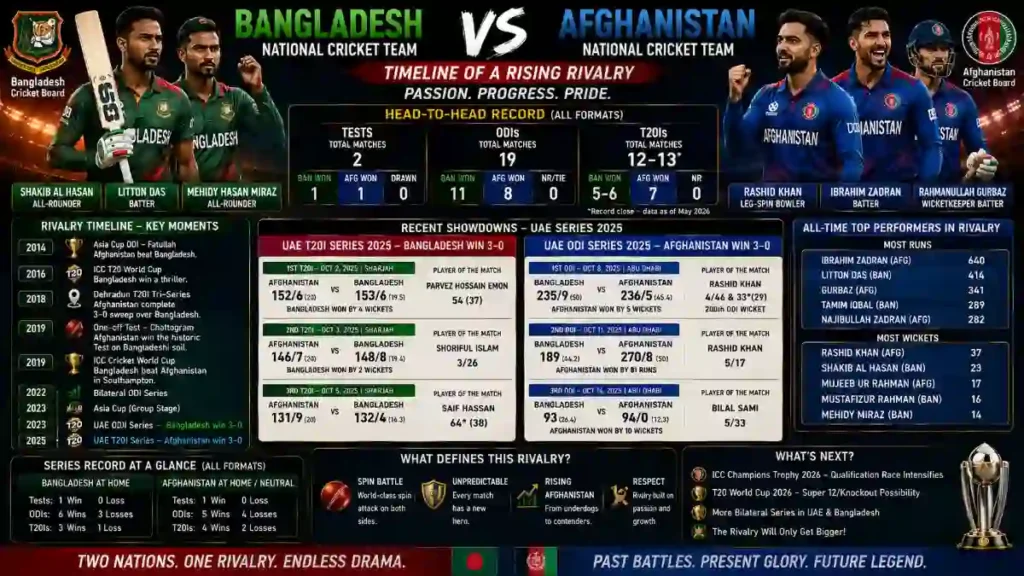

The Bangladesh National Cricket Team Vs Afghanistan National Cricket Team Timeline begins in 2014 and spans over 35 international matches across Tests, ODIs, and T20Is. Bangladesh lead the all-time head-to-head 17–16, but the rivalry is far from one-sided. Afghanistan won the only Test on Bangladeshi soil in 2019, swept the ODI series in UAE 3–0 in 2025, while Bangladesh took the T20I series 3–0 in the same tour. This is one of the most tactically complex and format-sensitive rivalries in Asian cricket.
Bangladesh vs Afghanistan Rivalry Timeline at a Glance
| Year | Event | Winner |
| 2014 | Asia Cup ODI Fatullah | Afghanistan |
| 2016 | T20 World Cup | Bangladesh |
| 2018 | Dehradun T20I Tri-Series | Afghanistan (3–0 sweep) |
| 2019 | One-off Test Chattogram | Afghanistan |
| 2019 | World Cup Southampton | Bangladesh |
| 2022 | Bilateral ODI Series | Bangladesh |
| 2023 | Asia Cup Group Stage | Bangladesh |
| 2025 | UAE T20I Series | Bangladesh (3–0) |
| 2025 | UAE ODI Series | Afghanistan (3–0) |
Phase 1 The Opener (2014–2017): Underdog vs Establishment
How the Bangladesh vs Afghanistan Cricket Timeline Actually Began
October 2025. Abu Dhabi. Afghanistan bat first, post 293, then bowl Bangladesh out for 93. A 200-run destruction.
This was not a shock result. This was the logical end-point of a rivalry that had been building match by match, series by series since 2014.
To understand why that scoreline hit so hard, you have to go back to Fatullah, Bangladesh. A cricket ground. An Asia Cup match. A team that had barely registered on global radar.
Afghanistan walked out with no Test status, no ICC ranking pressure, and nothing to lose. They walked off with a win.
That 2014 Asia Cup game was the first major marker in the Bangladesh vs Afghanistan cricket timeline. Bangladesh, a Full Member of the ICC since 2000, were expected to dominate a side that had only earned ODI status in 2009. What they got instead was a preview of how dangerous Afghanistan would become.
What People Remember vs What Actually Happened
Most fans remember this era as “Afghanistan upsets.” That framing is wrong.
What people think: Afghanistan got lucky in early matches against Bangladesh.
Reality: Afghanistan entered every game against Bangladesh with a clear tactical plan not hope. Their bowling attack had no fear of reputations. Their batting, while raw, was fearless. Bangladesh’s spin-heavy approach, designed for home conditions, was exactly the kind of bowling Afghanistan had been training against in domestic cricket.
In the 2016 ICC T20 World Cup, Bangladesh survived another scare. The match was tense until the final overs. Bangladesh won, but the dressing room knew the uncomfortable truth this team was not an anomaly. It was a trend.
Key Turning Point: The 2014 Asia Cup win gave Afghanistan’s players the psychological proof that Bangladesh could be beaten. That belief became the foundation of everything that followed.
Phase 2 The Power Shift (2018–2019): When Afghanistan Took Control
The ehradun Series The Moment the Timeline Changed
This is the single most important phase in the Bangladesh national cricket team vs Afghanistan national cricket team timeline.
The 2018 Dehradun T20I tri-series. Afghanistan beat Bangladesh 3–0. Clean sweep. Neutral venue. No home advantage for either side.
Think carefully about what this meant. Bangladesh had historically neutralised opponents using subcontinental spin on turning pitches. In Dehradun, that weapon was taken away. Rashid Khan’s leg-spin and Mujeeb Ur Rahman’s mystery bowling didn’t just dismiss Bangladesh’s batters they exposed the mental fragility underneath the technical limitations.
The Common Mistake Fans Make
Most people attribute the 2018 sweep purely to Afghanistan’s bowling being brilliant. That is only half the story.
The real reason Bangladesh lost: their middle order had no plan B. When Rashid landed his wrong’un, Bangladesh’s batters would either slog or freeze. Neither worked. Afghanistan’s batting, meanwhile, stayed composed under pressure. They didn’t panic when Bangladesh bowled well. Bangladesh did.
The 2019 Test Afghanistan’s Greatest Result Against Bangladesh
Then came Chattogram. September 2019. The first-ever Test match between these two sides.
Afghanistan won. On Bangladesh soil. Rashid Khan took 11 wickets across the match.
This is the most dramatic single result in the entire rivalry timeline. Bangladesh, playing at home, with a crowd behind them and conditions built for their spinners, were outspun by a team they had beaten in ODIs just months earlier. Rashid’s figures of 6/49 and 5/55 across two innings represent the most dominant individual bowling performance in this rivalry’s history.
For Afghanistan, this was not just a Test victory. This was their announcement that they belonged in the highest form of the game.
Read More About – United Arab Emirates National Cricket Team Vs Pakistan National Cricket Team Match Scorecard Full Breakdown, Key Stats & Turning Points
2019 World Cup Bangladesh Fight Back
The 2019 ICC Cricket World Cup provided a counterpoint. Bangladesh, led by a Shakib Al Hasan century in progress, beat Afghanistan in a tense Southampton encounter. Shakib’s 51-run contribution in a match Bangladesh won by 62 runs was exactly the kind of individual brilliance that rescues teams from tactical implosions.
But Rashid still took wickets. He always does.
Phase 3 The Modern Era (2022–2025): Who Really Owns This Rivalry?
A Rivalry With No Clear Owner
By 2022, the BAN vs AFG cricket history had entered its most complex phase. Neither team could be called the favourite with any certainty.
Bangladesh won a bilateral ODI series at home in 2022. The wins were rarely comfortable. Players like Mehidy Hasan Miraz stepped up in spin-versus-spin conditions, and Bangladesh’s deeper batting order gave them a structural advantage. But Afghanistan’s bowling made every total feel fragile. No score felt safe.
The 2023 Asia Cup group match brought another Bangladesh win but again, the margin disguised the effort required. Bangladesh were not dominant. They were resilient. There is a difference.
Key Insight: Bangladesh winning tight matches is not proof of superiority. It is proof of experience. Afghanistan losing close games is not proof of weakness. It is proof they are consistently competitive enough to make the result matter.
The 2025 UAE Series Bangladesh’s T20I Revival, ODI Disaster
The Series That Captured Everything About This Rivalry
No single series better defines the split nature of the Bangladesh vs Afghanistan cricket timeline than the October 2025 UAE bilateral.
Same squads. Same pitches. Same conditions. Two completely opposite outcomes.
T20I Series Bangladesh Win 3–0
Bangladesh won all three T20Is chasing. Not once did they bat first and set a target. That was not a coincidence it was a strategy.
| Match | Date | Winner | Margin | Key Performer |
| 1st T20I | Oct 2, 2025 | Bangladesh | 4 wickets | Parvez Hossain Emon (54 off 37) |
| 2nd T20I | Oct 3, 2025 | Bangladesh | 2 wickets | Shoriful Islam |
| 3rd T20I | Oct 5, 2025 | Bangladesh | 6 wickets | Saif Hassan (64* off 38) |
Rashid Khan still took 4/18 in the first T20I. Bangladesh still won. That tells you everything. Bangladesh decided they would rather chase on a used pitch with pace off the ball than hand Rashid fresh conditions on a dry surface while defending.
It was tactical intelligence, executed under pressure. A rare thing in this rivalry for Bangladesh.
ODI Series Afghanistan Dominant 3–0
Then the 50-over format arrived, and everything unravelled.
| Match | Date | Winner | Margin | Key Moment |
| 1st ODI | Oct 8, 2025 | Afghanistan | 5 wickets | Rashid Khan’s 200th ODI wicket |
| 2nd ODI | Oct 11, 2025 | Afghanistan | 81 runs | Rashid Khan: 5/17 in 8.3 overs |
| 3rd ODI | Oct 14, 2025 | Afghanistan | 200 runs | Bangladesh bowled out for 93; Bilal Sami 5/33 |
The counterintuitive truth most fans miss: Bangladesh won the T20I series not because they are a better team in the UAE. They won because the 20-over format compresses Afghanistan’s bowling advantage into fewer overs. Rashid gets 4 overs in a T20I. He gets 10 in an ODI. Over 50 overs, with the pitch breaking down and Bangladesh’s lower middle order exposed repeatedly, there is nowhere to hide.
The same squad. The same players. Two completely different series results. The format decided the outcome, not the talent gap.
Format-by-Format Dominance Breakdown
Who Wins and Why A Statistical Reality Check
| Format | Total Matches | Bangladesh Wins | Afghanistan Wins | Who Leads |
| Tests | 2 | 1 | 1 | Even |
| ODIs | 19 | 11 | 8 | Bangladesh |
| T20Is | 12–13 | 5–6 | 7 | Afghanistan |
Bangladesh’s ODI edge is real but thin. Several of their 11 ODI wins came by margins under 20 runs or less than a wicket in hand. Afghanistan’s T20I superiority is more decisive their wins frequently come by comprehensive margins.
The Analytical Layer Competitors Never Provide
Afghanistan’s T20I dominance is structural, not accidental. Rashid Khan, Mohammad Nabi, and Mujeeb Ur Rahman are three of the most economical T20 spinners in world cricket. Against Bangladesh’s historically spin-weak middle-order (particularly against wrist spin), this is a mismatch that batting technique alone cannot fix.
Bangladesh’s ODI strength is depth-based. Their batting order bats deeper seven or eight legitimate batters which absorbs Afghanistan’s bowling load better across 50 overs. This structural difference explains the format split almost entirely.
The Spin War The Tactical Identity of This Rivalry
Two Philosophies, One Battlefield
No rivalry in Asian cricket is more defined by spin bowling than the Bangladesh national cricket team vs Afghanistan national cricket team contest.
Bangladesh’s spin identity: Control, accuracy, variation in pace. Left-arm orthodox dominant. The goal is to dry up runs and create pressure over time. Shakib Al Hasan is the architect 23 ODI wickets against Afghanistan at an economy under 4.00, making him the most impactful single bowler in the rivalry’s history across both sides.
Afghanistan’s spin identity: Attacking with a plan. Wrist spin dominant. Rashid Khan’s leg-break with a disguised googly. Mujeeb’s ambidextrous grip variations. The goal is not just to restrict it is to dismiss, to create doubt, to make the batter second-guess every delivery. Rashid holds 17 T20I wickets against Bangladesh, more than any other bowler on either side in the shortest format.
The Psychological Hold
Here is what no competitor article ever explains about the AFG vs BAN cricket history: Bangladesh’s batters know exactly what Rashid Khan will bowl. They still cannot stop it.
That is not a technical failure. That is a psychological hold built across years of exposure, repeated collapses, and accumulated self-doubt. When Rashid comes on to bowl in the 15th over with Bangladesh needing 60 off 36, the dressing room has a memory. The scoreboard has a history.
Knowing what is coming and still being unable to execute is the hardest problem in batting. Afghanistan have created that problem for Bangladesh systematically.
Player Duels That Decided Matches
Shakib Al Hasan vs Rashid Khan
This is the rivalry within the rivalry. Two of cricket’s best all-rounders meeting as opponents.
Shakib: Chess player. Patient. Reads the game two overs ahead. His 51 in the 2019 World Cup was not a flashy innings it was the knock of a man who understood the only way to beat Rashid was to refuse to attack him on his terms.
Rashid: Instinctive. Explosive. Thrives on attacking batters who are thinking too much. His 11-wicket Test haul against Bangladesh remains the single greatest individual performance across any format in this rivalry.
Who wins this duel overall? Rashid, on statistics. But Shakib, on match-winning moments.
Rahmanullah Gurbaz vs Bangladesh’s New-Ball Attack
Gurbaz has become Afghanistan’s most dangerous match-shaper in T20Is against Bangladesh. His 40 off 31 in the 2025 1st T20I a match Afghanistan lost shows the pattern: Gurbaz gives Afghanistan a platform in the first six overs that Bangladesh must absorb or concede control entirely. The powerplay battle between Gurbaz and Bangladesh’s new-ball pace has become a decisive micro-contest in every recent T20I.
Ibrahim Zadran vs Bangladesh’s ODI Bowling
The standout statistical performer across the full Bangladesh vs Afghanistan head-to-head in ODIs is Ibrahim Zadran. His 640 ODI runs at an average of 53.33 against Bangladesh is the highest by any batter on either side in the 50-over format. He does not chase short balls. He does not panic against spin. He simply bats long, and Bangladesh’s bowling has not found a consistent answer.
All-Time Statistical Leaders in This Rivalry
| Category | Player | Team | Stat |
| Most ODI Runs | Ibrahim Zadran | AFG | 640 runs, avg 53.33 |
| Most T20I Runs | Mahmudullah | BAN | 194 runs |
| Most ODI Wickets | Shakib Al Hasan | BAN | 23 wickets |
| Most T20I Wickets | Rashid Khan | AFG | 17 wickets |
| Most Test Runs | Litton Das | BAN | 180 runs (highest: 121) |
| Best Test Bowling | Rashid Khan | AFG | 11 wickets in one match |
| Best ODI Figures | Rashid Khan | AFG | 5/17 (2025, Abu Dhabi) |
Key Tactical Contrast
| Dimension | Bangladesh | Afghanistan |
| Spin Style | Control, orthodox | Attack, wrist spin |
| Batting Approach | Structured, deep | Aggressive, top-heavy |
| Format Strength | ODI | T20I |
| Bowling Identity | Economy-first | Wicket-focused |
| Pressure Response | Experience-reliant | Intent-reliant |
Where This Rivalry Goes From Here
Afghanistan Are No Longer a One-Man Team
The most important development in the recent Bangladesh national cricket team vs Afghanistan national cricket team timeline is depth. Afghanistan no longer rely only on Rashid Khan.
Ibrahim Zadran has become a world-class ODI batter. Bilal Sami’s 5/33 in the 2025 3rd ODI announced a fast-bowling option that Bangladesh had no answer for. Rahmanullah Gurbaz provides explosive T20 starts. The squad is multi-dimensional in a way it simply was not in 2018 or 2019.
Bangladesh Must Fix ODI Cricket Structurally
The 93 all-out in Abu Dhabi in October 2025 was not an accident. Bangladesh’s batting middle order has a documented fragility against high-quality spin in non-home conditions. The averages across the 2023 and 2025 away series confirm a pattern: their top order scores runs, their middle order collapses, their lower order cannot compensate.
The fix is not tactical it is selection. Bangladesh need middle-order batters who have proven records against wrist spin. Until that changes, the ODI format of this rivalry will continue to tilt toward Afghanistan.
The Next Chapter
The next time these two sides meet whether at an ICC event or in a bilateral series neither team enters blind. Both sides know each other’s blueprint completely. What decides the result now is execution under pressure. Nerve. Intent. Individual brilliance on the day.On those measures, Afghanistan are currently ahead in T20Is and ODIs. Bangladesh lead in Tests and in the psychological weight of closer moments. The rivalry is genuinely even which is exactly what makes it worth watching.
Frequently Asked Questions
Q1. When did the Bangladesh vs Afghanistan cricket rivalry officially begin?
Ans. The rivalry began at the 2014 Asia Cup in Fatullah, where Afghanistan defeated Bangladesh in a major upset. This was the first significant match between the two sides and marked the starting point of the rivalry timeline.
Q2. What is the all-time head-to-head record between Bangladesh and Afghanistan?
Ans. Across 35+ matches, Bangladesh lead 17–16 overall. Bangladesh lead in ODIs (11–8), Afghanistan lead in T20Is (7–5/6), and Tests are level at 1–1 each.
Q3. Who won the first-ever Test match between Bangladesh and Afghanistan?
Ans. Afghanistan won the first-ever Test in Chattogram in September 2019, with Rashid Khan taking 11 wickets across the match. It remains Afghanistan’s most celebrated result against Bangladesh.
Q4. Who has taken the most wickets in this rivalry overall?
Ans. Shakib Al Hasan leads in ODIs with 23 wickets. Rashid Khan leads in T20Is with 17 wickets. Rashid also holds the best single-match figures 11 wickets in the 2019 Chattogram Test.
Q5. Who won the 2025 Bangladesh vs Afghanistan series in the UAE?
Ans. The series was split: Bangladesh won the T20I series 3–0, while Afghanistan won the ODI series 3–0. It is the first bilateral series in this rivalry where both teams completed a format sweep.
Q6. What is Rashid Khan’s record specifically against Bangladesh?
Ans. Rashid Khan has taken wickets against Bangladesh in nearly every match he has played against them. His most clinical performance was 5/17 in 8.3 overs in the 2nd ODI in Abu Dhabi, October 2025. He also holds the T20I record of 17 wickets against Bangladesh.
Q7. Which format does Afghanistan dominate in the BAN vs AFG cricket history?
Ans. Afghanistan hold a clear advantage in T20Is, winning 7 to Bangladesh’s 5–6. Their spin attack, led by Rashid and Mujeeb, is structurally suited to the 20-over format.
Q8. What is Bangladesh’s lowest total against Afghanistan?
Ans. Bangladesh were bowled out for 93 in the 3rd ODI in Abu Dhabi on October 14, 2025, losing by 200 runs. Bilal Sami took 5/33 to skittle Bangladesh inside 23 overs.
Q9. Who is the highest run-scorer in ODIs in this rivalry?
Ans. Ibrahim Zadran of Afghanistan leads with 640 ODI runs at an average of 53.33 against Bangladesh the highest by any batter on either side in the 50-over format.
Q10. What are the five biggest moments in the Bangladesh vs Afghanistan cricket timeline?
Ans.
Afghanistan’s 2014 Asia Cup win in Fatullah the rivalry’s origin point
The 2018 Dehradun T20I tri-series Afghanistan sweep Bangladesh 3–0
The 2019 Chattogram Test Afghanistan’s first-ever Test win, on Bangladesh soil
Bangladesh’s 2019 World Cup win Shakib’s composure saves them
The 2025 UAE bilateral a split series that perfectly captures the rivalry’s format-specific nature