
England and South Africa do not just play cricket against each other. They create the kind of contest where one session, one spell, or one bad decision can flip the match. That is why the rivalry keeps producing drama even when the scorecard looks calm on the surface.
What most people miss is this: this rivalry is built on contrast, not chaos. England bring structure, tempo, and batting intent. South Africa bring pace, athleticism, and the ability to make opponents uncomfortable under pressure. That clash is the real reason the keyword england cricket team vs south africa national cricket team deserves a full, authoritative rivalry page.
Why this rivalry stands out
This matchup works because both teams are strong enough to punish mistakes, but neither side is so dominant that the contest feels safe. England vs South Africa has always had the feel of a high-quality duel, not a mismatch. That is why the rivalry stays relevant across Tests, ODIs, and T20Is.
The deeper reason is psychological. These are teams that can control phases of a game, but they can also lose control quickly if the pressure rises. The result often changes faster than casual fans expect.
Snippet-friendly summary
England cricket team vs South Africa national cricket team is one of cricket’s most balanced rivalries. England have historically been stronger in Tests, South Africa have been slightly better in ODIs, and the T20I battle is very close. The matchup is decided more by pressure, spells, and tactical control than by one star performance alone.
Why readers stay hooked
- The contest rarely stays flat for long.
- Small moments carry big weight.
- The same series can swing twice in a week.
- One captaincy call can change the tone completely.
Rivalry timeline
A rivalry becomes more meaningful when you see how it evolved. England and South Africa have been meeting since the late 19th century, and the contest has moved through very different eras of cricket.
Early foundation
The first Test series between the two teams dates back to England’s tour of South Africa in 1888–89. That matters because it makes this rivalry one of the oldest in the game, not just one of the most watched.
Modern era shift
The rivalry became more tactical and more global as cricket professionalism expanded. South Africa’s return to international cricket in the early 1990s gave the matchup fresh energy, and since then the contest has grown into a major fixture in every format.
Recent trend
Recent series have shown how quickly momentum can swing. In the 2025 tour of England, South Africa won the first two ODIs, and England answered with a huge win in the third. That is the perfect example of why this rivalry keeps fans alert.
What people think vs reality
- People think rivalry history is just about old scorelines.
- Reality: the rivalry matters because each era has produced a different tactical battle.
- People think momentum is stable.
- Reality: England vs South Africa is famous for momentum flips.
Head-to-head record
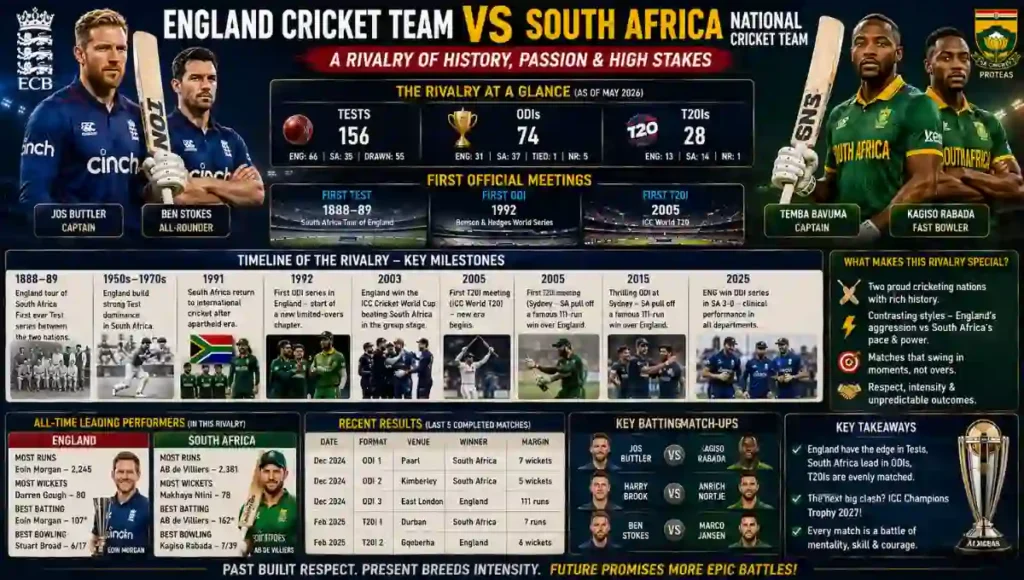
The numbers matter because they show how balanced this rivalry is across formats. England have the stronger Test record, South Africa lead in ODIs, and T20Is are tightly contested.
| Format | Total matches | England wins | South Africa wins | Other results |
| Tests | 156 | 66 | 35 | 55 draws |
| ODIs | 74 | 31 | 37 | 1 tie, 5 no result |
| T20Is | 28 | 13 | 14 | 1 no result |
What the record really tells us
The most important point is not just who leads where. It is that both teams have had periods of control, which makes the rivalry feel alive. England’s Test edge reflects long-format depth and historical consistency. South Africa’s ODI edge reflects their balance of pace, power, and fielding quality.
Format-by-format breakdown
Tests: the most layered battle
Test cricket is where England cricket team vs south africa national cricket team becomes deepest and most technical. The long format exposes temperament, patience, and bowling endurance. It also rewards teams that can survive difficult sessions without panic.
South Africa often create trouble with seam, bounce, and sustained pace. England usually respond with discipline, partnerships, and a stronger ability to settle once the first storm passes. That first new-ball phase is often the key battleground.
What decides Tests
- New-ball spells.
- Top-order survival.
- How well the middle order absorbs pressure.
- Whether the attack can keep control after the ball softens.
Real-world example
A Test can look even after the first innings, but one session of poor batting against movement can break the game open. That is why the first two days matter so much in this fixture.
ODIs: balance and collapse risk
ODIs have often leaned South Africa’s way more often than casual fans realise. South Africa usually bring a strong mix of fast bowling, athletic fielding, and disciplined batting. England, meanwhile, can look unstoppable when the top order clicks, but they can also expose themselves if they force scoring too early.
That is why this format has such a sharp rhythm. One side can dominate the powerplay, then lose control in the middle overs. The 2025 series in England showed exactly that pattern: South Africa built pressure, England answered hard, and the series never felt settled for long.
What decides ODIs
- Powerplay control.
- Middle-over tempo.
- Wicket preservation versus scoring pressure.
- Death-overs bowling.
Common mistake
Many fans judge ODI games only by the chase total or the final batting collapse. In this rivalry, the decisive work often happens several overs earlier.
T20Is: high tension, low margin
T20Is between England and South Africa are usually decided by tiny margins. One clean powerplay, one bad over at the death, or one dropped catch can be the difference. That is why this format feels so volatile between the two sides.
England’s batting depth makes them dangerous if they start fast. South Africa’s pace attack makes them dangerous if they strike early. In short cricket, both strengths can overwhelm the other team within minutes.
What decides T20Is
- Powerplay wickets.
- Boundary pressure.
- Death-over execution.
- Fielding quality under stress.
Counterintuitive truth
People think T20 is all about hitting. In this rivalry, control matters just as much as power. The team that handles pressure better usually wins.
Tactical matchups
The real battle is rarely just batter versus bowler. It is plan versus response. England often want tempo, scoring pressure, and forced mistakes. South Africa often want discomfort, wicket threat, and control through pace.
Pace attack vs batting intent
South Africa’s pace identity has long been one of their biggest weapons in this rivalry. When the ball is new and the pitch offers even a little movement, England’s top order can be tested quickly. That makes the first 10 overs in ODIs and the first hour in Tests extremely important.
England’s reply is usually aggression. Their batting is built to break pressure early if the innings survives the opening spell. That is why this matchup can change so quickly. Survival creates scoring freedom.
Captaincy and field placement
A common mistake is to focus only on batters. In this rivalry, captaincy decisions have repeatedly shaped momentum. The side that uses bowling changes better, protects weaker phases, and avoids panic field settings usually gets the edge.
What users should watch
- The first bowling spell.
- How captains manage the powerplay.
- Whether the middle order is rebuilding or attacking.
- The quality of fielding under pressure.
Historical milestones
A definitive rivalry page needs more than analysis. It also needs memory. England vs South Africa has delivered famous series, major collapses, and turning-point performances across generations.
Key historical layers
- The rivalry began in the 1888–89 Test series.
- South Africa’s return to the international game in the 1990s gave the contest a new modern chapter.
- White-ball cricket added more volatility and more opportunity for late swings.
- Recent series have shown that neither side can assume control for long.
Why this matters for SEO and readers
Users searching this keyword are not only looking for records. They also want context, milestones, and the matches that shaped the rivalry. That is where many competitor pages stay shallow. They give the number, but not the meaning.
Venue dynamics
Venue conditions matter a lot in this rivalry because both teams can look much stronger in the right environment.
England-friendly conditions
- Swing or seam movement.
- Overcast conditions.
- Helpful new-ball phases.
- Surfaces that reward patience.
South Africa-friendly conditions
- Extra pace and bounce.
- Harder surfaces.
- Conditions that reward fast-bowling pressure.
- Games where England’s top order is forced into risk.
What people think vs reality
People assume home advantage is just about familiarity. In this rivalry, it is also about whether the pitch suits pace, movement, or batting tempo. That is a bigger tactical factor than many casual previews admit.
Record holders to know
If you want this article to feel complete, you need record-holder context. This is where the page becomes more useful than a generic rivalry explainer.
Useful record angles
- Most runs in the rivalry.
- Most wickets in the rivalry.
- Best bowling figures in an innings.
- Biggest batting totals in a series.
- Most dominant captaincy runs in a format.
These record sections matter because they give the page documentary value. They also create natural internal linking opportunities to player pages, scorecards, and series archives.
What decides wins
If you want to understand who wins England vs South Africa matches, stop looking only at batting averages. Start looking at three things.
- New-ball control.
- Middle-over pressure.
- Death-over execution.
Those three phases often decide the result more than one huge innings. In Tests, the first and second new-ball spells matter. In ODIs, middle overs can either stabilize or choke a chase. In T20Is, death bowling separates control from chaos.
Practical reading guide
- If England survive the opening burst, they usually become more dangerous later.
- If South Africa win the first bowling phase, they often force the game into their rhythm.
- If either side loses discipline in the middle overs, the match can flip fast.
Common mistake in analysis
Many summaries overrate highlight moments and underrate the boring overs in between. That is a mistake. In this rivalry, the quiet overs are often the reason the dramatic overs matter.
Read More About – Pakistan National Cricket Team Vs New Zealand National Cricket Team
Recent trend and future angle
Recent England-South Africa cricket has shown a familiar pattern: the series rarely stays flat for long. The 2025 tour in England saw South Africa take early control in the ODIs before England responded strongly, and the T20 leg also carried the same tension before weather interrupted the final game.
The lesson is simple. Do not assume momentum is permanent in this fixture. The team that looks flat in one match can look dangerous again two days later. That is why this rivalry works so well for readers and why the search demand stays strong.
Frequently Asked Questions
Q1. Who has the better head-to-head record, England or South Africa?
Ans. England lead the Test record, South Africa lead in ODIs, and T20Is are very close.
Q2. Why is England vs South Africa such a strong rivalry?
Ans. Because the teams are well matched, and their styles create pressure-heavy cricket with frequent momentum shifts.
Q3. Which format is most competitive between England and South Africa?
Ans. ODIs and T20Is are especially tight, while England have had the stronger long-term Test record.
Q4. What usually decides England vs South Africa matches?
Ans. New-ball spells, middle-over control, death bowling, and captaincy decisions.
Q5. Which team has been better in Tests?
Ans. England have won more Tests overall in the head-to-head record.
Q6. Which team has been better in ODIs?
Ans. South Africa have the better ODI head-to-head record.
Q7. Are England vs South Africa matches usually high scoring?
Ans. Not always. Many are decided by pressure, wickets, and one key passage rather than pure batting volume.
Q8. What makes South Africa dangerous against England?
Ans. Their fast bowlers, athletic fielding, and ability to create discomfort early in the innings.
Q9. What makes England dangerous against South Africa?
Ans. Their batting depth, aggressive tempo, and ability to turn a game quickly once they settle.
Q10. Is this rivalry more important in Tests or white-ball cricket?
Ans. It matters in both, but Tests give the rivalry its deepest historical weight while white-ball games often produce faster swings.
Q11. What is the oldest part of this rivalry?
Ans. The rivalry began with England’s Test tour of South Africa in 1888–89.
Q12. What is the biggest tactical theme in this matchup?
Ans. Pressure management. The team that handles pressure phases better usually controls the match.