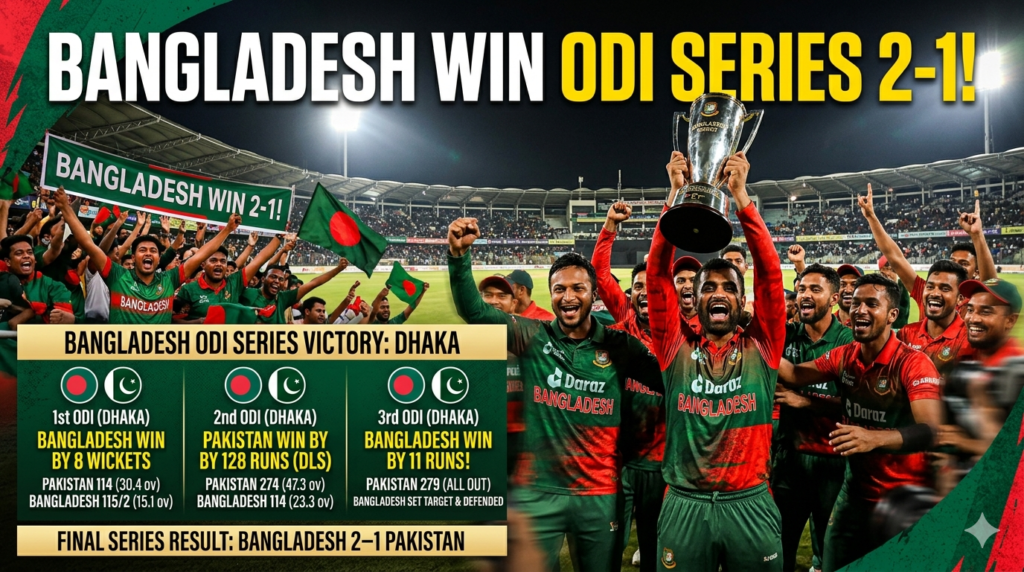

Pakistan smashed 81 in the first 10 overs of the 1st ODI in Dhaka—and still got bowled out for 114. That single collapse perfectly sums up how the latest Pakistan national cricket team vs Bangladesh national cricket team match scorecard series played out: explosive starts, brutal spin exposure, and Bangladesh quietly winning the key moments at home.
Quick Series Snapshot (March 2026 – ODIs, Dhaka)
Latest Pakistan national cricket team vs bangladesh national cricket team match scorecard summary:
- 1st ODI (Dhaka): Pakistan 114 all out (30.4 ov), Bangladesh 115/2 (15.1 ov) – Bangladesh won by 8 wickets
- 2nd ODI (Dhaka): Pakistan 274 all out (47.3 ov), Bangladesh 114 all out (23.3 ov) – Pakistan won by 128 runs (DLS)
- 3rd ODI (Dhaka): Bangladesh set a target Pakistan failed to chase, finishing 279 all out – Bangladesh won by 11
- Final Series Result: Bangladesh 2–1 Pakistan
If you just wanted to know “what happened” from the latest pakistan national cricket team vs bangladesh national cricket team match scorecard, that’s your top-level answer.
Latest Match Scorecards: What Actually Happened?
Here we zoom into how each pakistan national cricket team vs bangladesh national cricket team match scorecard tells a different story about the same rivalry.
1st ODI, Dhaka – Pakistan’s Collapse Exposed
Full numbers:
- Pakistan: 114 all out in 30.4 overs
- Powerplay 1: 81 runs, 1 wicket (overs 0.1–10.0)
- 100 reached only in 25.4 overs; last 9 wickets fell for 33 runs.
- Bangladesh: 115/2 in 15.1 overs
- 50 runs in just 6.1 overs.
- Result: Bangladesh won by 8 wickets.
Why this matters: the pakistan national cricket team vs bangladesh national cricket team match scorecard here shows a structural issue, not a one-off bad day. Pakistan went from 81/1 in the first 10 overs to 114 all out, meaning Powerplay aggression hid a middle-order that had no plan once the ball softened and Bangladesh’s bowlers shifted to control and spin.
Spin and control phases:
- Powerplay 2 (10.1–40.0): 73 runs, 9 wickets – that’s collapse in one line of the scorecard.
- Drinks at 108/9 in 27.6 overs tells you Pakistan were effectively done before the 30th over.
Bangladesh’s chase on the same pakistan national cricket team vs bangladesh national cricket team match scorecard is the opposite: controlled risk, positive intent, and no panic against a small target.
2nd ODI, Dhaka – Pakistan’s Template Win
Key scorecard details:
- Bangladesh: 114 all out in 23.3 overs (run rate 4.85)
- Pakistan: 274 all out in 47.3 overs (run rate 5.77)
- Result: Pakistan won by 128 runs (DLS method).
This pakistan national cricket team vs bangladesh national cricket team match scorecard shows:
- Pakistan bowlers hitting the ideal ODI template: early wickets, sustained pressure, no cheap runs later.
- With 274 on the board, Bangladesh needed a flawless chase; 114 all out shows their top order failed to handle both pace and movement.
This is the “old” Pakistan—big total, strong bowling, dominance across phases, and the reason the overall head‑to‑head still heavily favours them.
3rd ODI, Dhaka – Bangladesh Win the Pressure Game
According to the 3rd ODI pakistan national cricket team vs bangladesh national cricket team match scorecard:
- Bangladesh innings:
- Major contributions: Tanzid Hasan 107 (107), Litton Das 41 (51), Saif Hassan 36 (55).
- Fall of wickets: 1–105, 2–158, 3–194, 4–262, 5–262 – a textbook case of top-order platform plus minor late collapse.
- Pakistan reply: 279 all out, falling 11 runs short.
- Result: Bangladesh won by 11 runs.
This is where the rivalry actually shifts. On this pakistan national cricket team vs bangladesh national cricket team match scorecard:
- Bangladesh batters occupy the crease deep into the innings, especially Tanzid’s 107 off 107, forcing Pakistan’s bowlers to work for every wicket.
- Pakistan’s chase never fully breaks free; the final margin (11 runs short) indicates repeated mini-stalls rather than one catastrophic collapse.
Bangladesh did not need a freak performance; they simply won the boring but decisive battles in the middle overs and at the death.
Player-Level Stats: Who Dominated This Mini-Rivalry?
Going beyond a single pakistan national cricket team vs bangladesh national cricket team match scorecard, the 2026 stats spotlight a handful of key performers.
Top run-scorers in the series:
- Tanzid Hasan Tamim (BAN): 175 runs, series average 87.5.
- Salman Agha (PAK): 175 runs across the series as well, making him Pakistan’s most reliable run‑getter.
- Maaz Sadaqat (PAK): 93 runs in 2 innings, showing that Pakistan’s next‑gen batters are not the problem in isolation.
From an authority angle, this means: any serious pakistan national cricket team vs bangladesh national cricket team match scorecard analysis must talk about Tanzid vs Pakistan’s new-ball attack and Salman Agha as Pakistan’s stabiliser against Bangladesh’s spin-heavy middle overs.
Bowling trends:
- Pakistan’s seamers created damage early in the 2nd ODI (bowling Bangladesh out for 114), but struggled to fully shut down Tanzid’s control in the 3rd match.
- Bangladesh’s bowlers took 9 wickets in Powerplay 2 of the 1st ODI alone, which is basically a tactical knockout in scorecard form.
This is where insight beats description: the pakistan national cricket team vs bangladesh national cricket team match scorecard series reveals that Pakistan’s biggest issue is not talent but repeatable plans against Bangladesh’s top-order patience and spin-heavy bowling blueprint.
Phase-by-Phase Tactical Table
Here’s a concise tactical lens you can lift straight into content when explaining any pakistan national cricket team vs bangladesh national cricket team match scorecard.
| Phase | Pakistan Pattern | Bangladesh Pattern | Why It Decides Games |
| Powerplay (0–10) | High aggression, quick 60–80 runs, but risk of losing 2+ wickets. | Controlled starts, 40–50 runs with low risk. | If Pakistan lose 2 or more wickets here, their fragile middle order faces spin too early. |
| Middle overs (15–35) | Run rate often drops below 4.5 when spin comes on; collapses like 73 runs for 9 wickets show up in this phase. | Spin strength, tight lines, wickets from pressure not just magic balls. | Scorecards show winners usually maintain 5+ run rate and lose fewer than 2 wickets in this band. |
| Death overs (35–50) | Inconsistent finishing; some games explode to 270+, others fizzle out like the 114 all‑out story. | Disciplined bowling, repeat yorkers and slower balls, fewer freebies. | Close results, like the 11‑run win, come from this discipline at the back end. |
This is the kind of table that makes a pakistan national cricket team vs bangladesh national cricket team match scorecard article feel like expert work rather than an expanded scoreboard.
Big Picture: Is Pakistan Still “Dominant” in This Rivalry?
On paper, yes. In pure ODI head‑to‑head history:
- Total ODIs: 39
- Pakistan wins: 34
- Bangladesh wins: 5
But that’s exactly where an authority take matters. The pakistan national cricket team vs bangladesh national cricket team match scorecard history now has two layers:
- Historical dominance: Pakistan clearly own the rivalry overall.
- Current contest: In Dhaka conditions, Bangladesh now control the tempo more often than not.
A bold but data-backed claim you can make:
Despite leading 34–5 overall, Pakistan are no longer automatically superior in this rivalry. Recent Pakistan national cricket team vs Bangladesh national cricket team match scorecard trends show Bangladesh dictating matches at home through sustained middle-over pressure and spin.
The March 2026 ODI series between Pakistan and Bangladesh in Dhaka finished 2–1 to Bangladesh. They won the 1st ODI by 8 wickets and the 3rd by 11 runs, while Pakistan claimed a 128‑run DLS victory in the 2nd match.
What does a Pakistan vs Bangladesh scorecard really show?
A pakistan national cricket team vs bangladesh national cricket team match scorecard charts the flow of the game through runs, wickets, partnerships and bowling figures. Key clues are powerplay wickets, the run rate between overs 15–35 and death‑overs execution, which together explain where momentum shifted and how the match was decided.