
October 24, 2021. Dubai. Shaheen Shah Afridi bowls Rohit Sharma first ball. Then Rahul. Then Kohli — caught at mid-on for zero. India are 6 for 3. The stadium is stunned. Pakistan win their first T20 World Cup match against India in the tournament’s history. The india national cricket team vs pakistan national cricket team timeline includes matches from 1952 to the present.
That single evening reset how millions of fans remembered the last fifteen years of this rivalry.
This is what the India–Pakistan cricket timeline actually does. It does not just store results. It rewrites perception. Every match carries a weight that no other fixture in world cricket can replicate.
This article gives you the full rivalry timeline by era, the matches that genuinely changed the story, and the context that raw stats tables never explain.
India vs Pakistan Rivalry at a Glance
The India national cricket team vs Pakistan national cricket team timeline begins in 1952 and runs through ICC tournaments, Asia Cup clashes, and rare bilateral series across more than seven decades.
What you need to know immediately:
- The rivalry spans Tests, ODIs, T20Is, and every major ICC event.
- They no longer play regular bilateral series. Today, every match happens inside a multi-team tournament — an ICC event or the Asia Cup.
- That scarcity has made each fixture feel even larger. Fewer games. More pressure per game.
- The rivalry’s emotional weight comes less from aggregate win-loss totals and more from a small number of pressure matches that fans carry across generations.
What most people miss is this: India vs Pakistan is not one rivalry. It is four different rivalries depending on the format and the era — each with its own momentum, its own heroes, and its own defining trauma.
India vs Pakistan Head-to-Head Snapshot (Before the Timeline)
Before diving into the timeline, here is how the formats stack up at a high level.
| Format | Matches Played (approx.) | Notes |
| Tests | ~60 | Last Test series: 2007–08; heavily India-dominant in modern era |
| ODIs | ~130+ | Large bilateral history; Sharjah era inflated numbers |
| T20Is | ~20+ | Fewer meetings; highest-pressure format per match |
(Head-to-head totals shift with every new fixture. Always verify against a live source like ESPNcricinfo for exact current counts.)
Why Raw Numbers Don’t Tell the Full Story?
Here is the real problem with how most pages present this data: they give you totals and stop there.
But Pakistan dominated early Test cricket between these two teams. India’s ODI record improved dramatically in the 2010s. And in T20Is — the format everyone watches now — the record has swung back and forth dramatically.
Three things the aggregate totals hide:
- Bilateral era vs ICC era: Most of India’s losses to Pakistan happened during the Sharjah-era bilateral matches. In ICC knockout pressure games, the record tells a different story.
- Neutral-venue dynamics: These teams almost never play on home soil against each other. Neutral venues remove one of cricket’s biggest variables.
- Pressure-game memory: Fans remember three Kohli chases more vividly than ten routine bilateral wins. Memory is not democratic. It clusters around moments.
India vs Pakistan Cricket Timeline: Rivalry by Era
1952–1978: The Rivalry Begins
1952 — Pakistan tours India for the first Test series between the two nations. Pakistan win the first-ever Test between the sides in Delhi. It is just five years after Partition. These matches are not yet a media spectacle. They are something more raw: a meeting between two nations that shared a single cricketing culture weeks before they became two separate countries.
The rivalry in this phase is stop-start. Political tensions cut fixture lists. India and Pakistan play a handful of Test series through the 1950s and 1960s, then matches are suspended entirely for years following the 1965 and 1971 wars.
What most people miss is that the early rivalry was actually quite competitive — and often low-scoring, technically demanding Test cricket. It was not yet the high-voltage white-ball drama that defines modern fan memory.
What changed: Limited-overs cricket was about to transform everything.
1978–1995: ODIs Turn the Rivalry into Appointment Viewing
Pakistan resume cricketing ties with India in the late 1970s. Then ODIs arrive — and the rivalry becomes a different animal.
Key shift: By the mid-1980s, the Sharjah Cup and other neutral-venue tournaments in the UAE turn India vs Pakistan into appointment television across South Asia and the diaspora. Games in Sharjah in particular carry a mythology of last-ball drama, nerve-shredding chases, and star performances.
1986 Austral-Asia Cup final in Sharjah — Javed Miandad’s last-ball six off Chetan Sharma. If you want a single moment that explains why Pakistan’s fans have always believed in their team’s ability to produce miracles under pressure, start here.
This era also sees the rise of players — Imran Khan, Kapil Dev, Sunil Gavaskar, Javed Miandad, later Sachin Tendulkar and Wasim Akram — whose personal rivalries become layered inside the national one.
Counterintuitive idea: Pakistan were arguably the more feared team in this era. India’s modern dominance in white-ball cricket is a later story. Fans who only know India since 2013 are missing the full picture.
1996–2011: The Pressure-Match Era and the Global Peak
This is the era that most fans over 30 treat as the emotional centre of the rivalry.
1996 World Cup quarter-final, Bangalore — India win in front of a raucous home crowd. But here’s the real problem: this match left a bitter taste on both sides. Pitch conditions, crowd pressure, and a disputed Pakistani batting collapse made it one of the rivalry’s most discussed and debated results.
1999 — Political tensions peak. The Kargil conflict freezes bilateral cricket again. Cricket and geopolitics become inseparable in a way that is unique to this rivalry.
2003 World Cup, Centurion — Sachin Tendulkar’s 98 off 75 balls dismantles Pakistan’s bowling attack. India win easily. It becomes one of the most-replayed innings in ODI history — not because of the situation, but because of the sheer dominance of a player who had already been carrying the weight of this fixture for a decade.
2004 — A rare bilateral thaw. Pakistan tour India for the first time in nearly fifteen years. The series is peaceful, even celebratory. Cricket diplomacy at its most visible.
2007 T20 World Cup final, Johannesburg — The first T20 World Cup final. India win off the last ball with Misbah-ul-Haq’s attempted scoop going straight into Sreesanth’s hands. A new format, a defining match, a rivalry moment that belongs to both teams’ trauma archives.
2011 World Cup semi-final, Mohali — One of the most-watched cricket matches ever played. India win by 29 runs. Sachin Tendulkar scores 85. The Pakistani pace attack, led by Umar Gul, makes it uncomfortable. But India hold. Every player on both sides says they felt the pressure differently to any other match they had played.
This is where things get important: the 2011 semi-final was not the most dramatic match in the rivalry. It was not the closest. But it may have been the most pressurised — and pressure is the currency this rivalry trades in.
2012–Present: Event-Driven Rivalry, Fewer Meetings, Bigger Spikes
After 2013, bilateral cricket between India and Pakistan effectively stops. Political relations deteriorate. The BCCI and PCB cannot agree on scheduling. The rivalry moves entirely into ICC events and the Asia Cup.
2017 Champions Trophy final, The Oval — Pakistan produce one of the great upsets in recent ICC history, beating India by 180 runs. Fakhar Zaman scores a century. The Indian batting collapse is stunning. For Pakistan fans, it resets the narrative after years of ICC tournament losses.
2021 T20 World Cup, Dubai — Shaheen Afridi’s opening burst. Pakistan win for the first time in T20 World Cup history against India. The scoreline — 10 wickets — makes it historic. More importantly, it changes the psychological posture of the rivalry.
2022 T20 World Cup, Melbourne — 90,000 fans — India chase 160 with Virat Kohli scoring an unbeaten 82, including a final-over dismantling of Haris Rauf. India win off the last ball. The match is immediately placed among the greatest limited-overs chases in history.
2023 Asia Cup and ODI World Cup — India maintain dominance in the ODI format at this stage of the rivalry’s modern chapter.
2025 Champions Trophy — The latest chapter in the ICC event rivalry, with the fixture already generating the familiar wave of buildup, prediction, and pressure before a ball is bowled.
The Matches That Changed the India-Pakistan Rivalry
Some results merely add to the win-loss column. These matches changed the story itself.
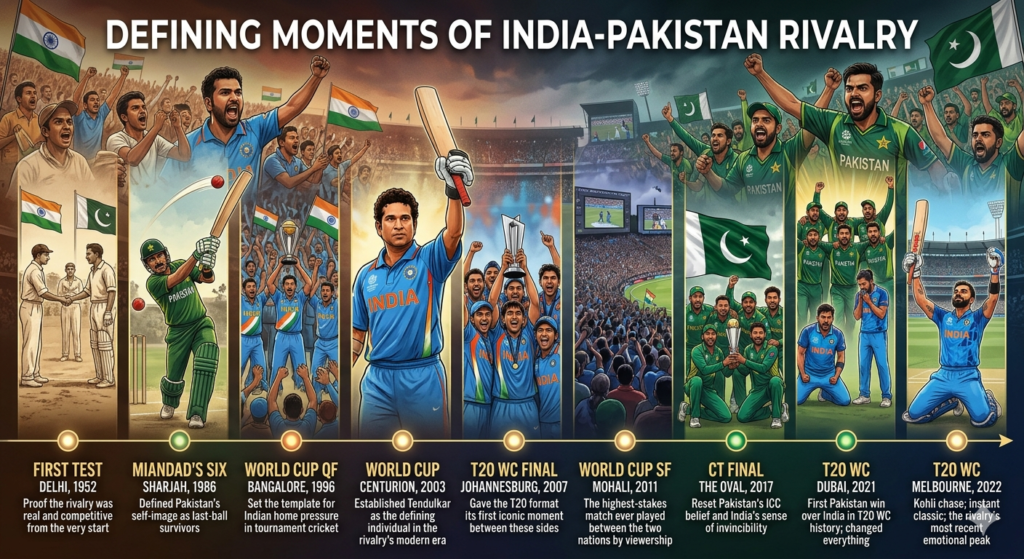
| Match | Year | Why It Changed the Rivalry |
| First Test, Delhi | 1952 | Proof the rivalry was real and competitive from the very start |
| Miandad’s six, Sharjah | 1986 | Defined Pakistan’s self-image as last-ball survivors |
| World Cup QF, Bangalore | 1996 | Set the template for Indian home pressure in tournament cricket |
| World Cup, Centurion | 2003 | Established Tendulkar as the defining individual in the rivalry’s modern era |
| T20 WC Final, Johannesburg | 2007 | Gave the T20 format its first iconic moment between these sides |
| World Cup SF, Mohali | 2011 | The highest-stakes match ever played between the two nations by viewership |
| CT Final, The Oval | 2017 | Reset Pakistan’s ICC belief and India’s sense of invincibility |
| T20 WC, Dubai | 2021 | First Pakistan win over India in T20 WC history; changed everything |
| T20 WC, Melbourne | 2022 | Kohli chase; instant classic; the rivalry’s most recent emotional peak |
Original observation: Notice the pattern. India tend to dominate format-defining matches early in a tournament’s lifespan — and Pakistan find a way to produce one reset result per generation that forces everyone to recalibrate. That cycle is the rivalry.
Timeline Within the Timeline: ICC and Asia Cup Meetings
Most fans searching for the India–Pakistan timeline are really looking for this: the major-event meetings. Here is the tournament-by-tournament framework.
ODI World Cup Meetings
India and Pakistan have met at multiple World Cups since 1992. India’s World Cup record against Pakistan in the ODI format is remarkably strong — they have not lost a 50-over World Cup match against Pakistan.
But this is also where context matters. Winning when the pressure is absolute is a skill. India have shown it repeatedly in this format. Pakistan fans rightly point out that bilateral records and this particular World Cup metric are very different things.
Takeaway: If you are comparing teams purely on ODI World Cup record, India lead decisively. If you are measuring overall competitive quality across eras, the picture is more complex.
T20 World Cup Meetings
The T20 format has produced some of the rivalry’s most volatile results. Pakistan’s 2021 win ended years of T20 WC hurt. India’s 2022 chase instantly responded. Every T20 WC meeting between these sides since 2007 has had genuine match-of-the-tournament quality.
Counterintuitive insight: Pakistan are actually competitive — sometimes dominant — in T20I cricket broadly. Their T20 WC record against India specifically was poor for a long time, which is what made the 2021 result so cathartic for their fans.
Champions Trophy and Asia Cup
The 2017 Champions Trophy final remains Pakistan’s most significant ICC result against India in the modern era. The Asia Cup has provided a consistent stage — often producing close finishes and superstar individual performances even when the broader political environment is frozen.
Why India and Pakistan Rarely Play Bilateral Cricket Now?
This question sits behind almost every search on this topic. Here is the straightforward answer.
The reason is political, not cricketing.
India and Pakistan have had no regular bilateral cricket since 2013. The Board of Control for Cricket in India (BCCI) follows the Indian government’s position, which has been that bilateral ties are inappropriate given ongoing diplomatic tensions. Pakistan Cricket Board (PCB) has repeatedly pushed for a resumption; India has declined.
The ICC has limited power to compel member boards to play bilateral series.
What this means for the rivalry:
- There are roughly two to four India–Pakistan fixtures per year in a good year — and some years, none.
- Every meeting is tournament cricket. Every match is effectively a knockout in terms of emotional stakes.
- The buildup, media coverage, and fan pressure for each game now dwarfs what a bilateral series match would receive.
Bold opinion: The scarcity has, paradoxically, made the rivalry more powerful. If these teams played a five-match ODI series every year, Shaheen’s 2021 opening burst would not carry the weight it does. Rarity creates mythology.
What Makes This Rivalry Different From Any Other Head-to-Head?
Pressure vs frequency — Most great rivalries involve teams playing constantly. This one mostly does not. Yet it generates more global interest per match than almost any other fixture in sport.
Memory vs math — Aggregate totals show one story. The matches that live in fan memory tell another. The rivalry is defined more by unforgettable individual moments than by which side has more wins.
Generations, diaspora, and media — A British-Indian fan watching in Birmingham and a Pakistani fan in Lahore are both watching the same match with completely different emotional histories. The diaspora element makes this rivalry global in a way few cricket fixtures achieve.
Beginner takeaway: You do not need 70 years of context. Watch the 2007 T20 final, the 2017 Champions Trophy final, the 2021 T20 WC match, and the 2022 Melbourne chase. Those four matches alone explain most of what the rivalry feels like today.
Advanced takeaway: The rivalry is best understood not through totals but through era shifts. Each era has its own dominant team, its own defining format, and its own pressure point. The timeline is not a straight line — it is a series of resets.
Conclusion
The India national cricket team vs Pakistan national cricket team timeline is not like any other. Seven decades of matches. Decades of political suspension. Matches so infrequent that each new one arrives with the weight of a hundred games it is standing in for.
The timeline shows a simple truth: this rivalry does not need volume to produce significance. It needs one match. One spell. One chase. And then everything resets again.
Every new fixture — from whatever tournament it falls in — immediately becomes part of a timeline that fans have been tracking, emotionally and personally, since 1952.
That is what no head-to-head table can capture. And that is what makes this timeline worth knowing.
FAQ: India vs Pakistan Timeline Questions Fans Actually Ask
When did India and Pakistan first play each other in cricket?
India and Pakistan played their first Test match in October 1952 in Delhi, as part of Pakistan’s inaugural tour of India. Pakistan won that first Test — a result that set the competitive tone from the very beginning.
What is the most famous India vs Pakistan match?
It depends on the generation. For fans of the 1980s, Miandad’s last-ball six in Sharjah (1986). For the 2000s generation, the 2007 T20 World Cup final or the 2011 World Cup semi-final in Mohali. For modern fans, Shaheen’s 2021 T20 WC burst or Kohli’s 2022 Melbourne chase. Each era has its own defining match.
Why do India and Pakistan mostly meet in ICC events now?
Political tensions between the two countries have suspended regular bilateral cricket since 2013. The BCCI reflects the Indian government’s position on bilateral ties. As a result, India and Pakistan only meet in multi-team ICC tournaments (T20 World Cup, ODI World Cup, Champions Trophy) and the Asia Cup. The ICC cannot force bilateral scheduling.
Which India vs Pakistan matches are the best to watch or rewatch?
- 2007 T20 World Cup Final — For the format’s birth moment and Misbah’s agonising last shot
- 2011 World Cup Semi-Final, Mohali — For pure pressure-match drama
- 2017 Champions Trophy Final — For Pakistan’s most complete ICC performance against India in modern memory
- 2021 T20 World Cup, Dubai — For Shaheen Afridi’s demolition of India’s top order
- 2022 T20 World Cup, Melbourne — For Kohli’s last-over chase; arguably one of T20I cricket’s finest individual innings
Is the rivalry bigger in Tests, ODIs, or T20Is?
Historically, Test cricket carried the most weight. Culturally and emotionally today, T20Is generate the biggest immediate global reaction — partly because there are fewer of them and every one feels critical. ODIs, particularly at World Cups, still produce the rivalry’s most scrutinised results. The rivalry has genuinely shifted format by format across seven decades.